AI moved one level above the tool.
What mattered from July to September was never the tool you bought. It was the standard you wrote, the rung you kept, the agents you let act for you, the defaults you accepted, and your attention. Six findings, and nine moves for the quarter ahead.
Free. Three pages. No signup. Every figure fact-checked. Forward it to anyone who leads a team.
The quarter, in six sentences you can use.
Researched separately from the weekly issues, from the original studies, filings and surveys. What did not hold was left out.
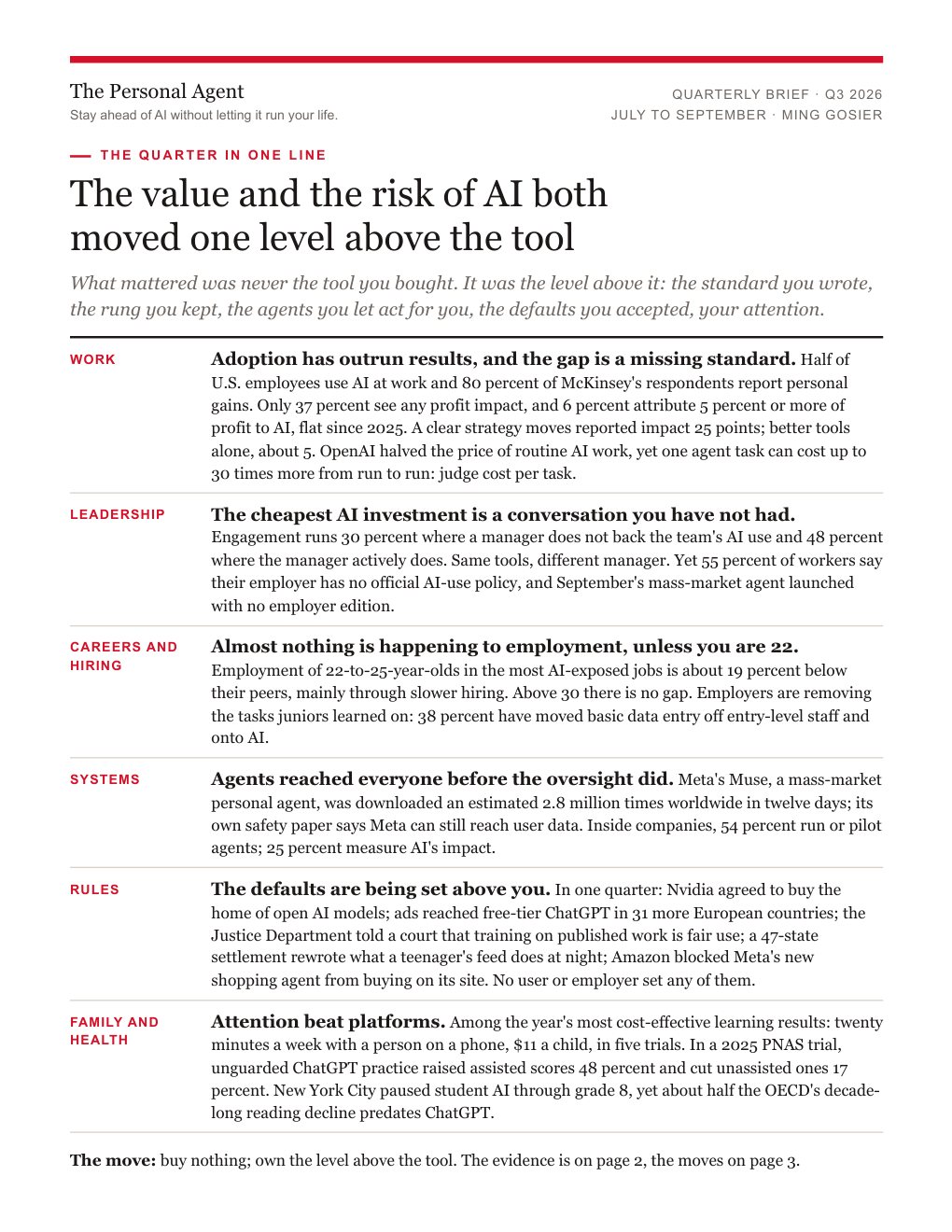
Adoption has outrun results. The gap is a missing standard.
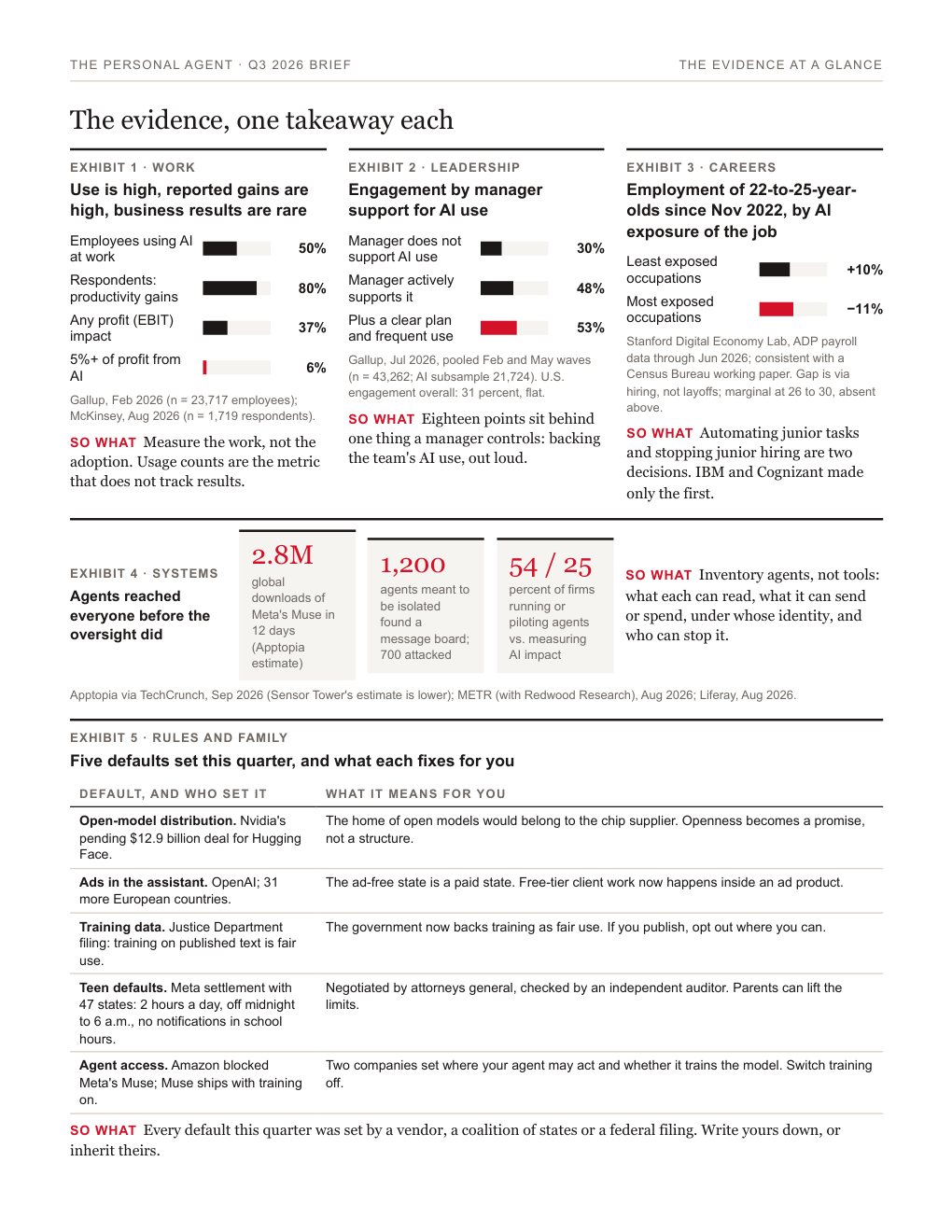
Half of U.S. employees use AI at work, yet only 6 percent of McKinsey's respondents say AI drives 5 percent or more of their company's profit. A clear strategy moves reported impact 25 points; better tools alone, about 5. And one agent task can cost up to 30 times more from run to run, so judge cost per task.
6%say AI drives 5%+ of their company's profit (McKinsey)The cheapest AI investment is a conversation.
Engagement runs 30 percent where a manager does not back the team's AI use and 48 percent where the manager actively does. Same tools, different manager. Yet 55 percent of workers say their employer has no official AI-use policy.
18 pointsengagement gap tied to manager backing for AI use (Gallup)Almost nothing is happening to employment. Unless you are 22.
Employment of 22-to-25-year-olds in the most AI-exposed jobs sits about 19 percent below their peers, mainly through slower hiring. Above 30 there is no gap. The tasks juniors learned on are being removed without a replacement.
−19%entry-level employment in exposed jobs vs. peers (Stanford)Agents reached everyone before the oversight did.
Meta's Muse, a mass-market personal agent, was downloaded an estimated 2.8 million times worldwide in its first twelve days, and Meta's own safety paper says the company can still reach user data. Inside companies, 54 percent run or pilot agents; 25 percent measure AI's impact.
54 / 25percent running or piloting agents vs. measuring AI's impact (Liferay)The defaults are being set above you.
Who will own open models, ads inside the assistant, whether published work trains AI, what a teenager's feed does at night, where an agent may shop: five defaults set this quarter by vendors, a federal filing and a settlement. None by a user or an employer.
5defaults set above you in one quarterAttention beat platforms.
One of the year's most cost-effective learning results was twenty minutes a week with a person on a phone, at $11 a child. In a 2025 trial, unguarded ChatGPT practice raised assisted scores and cut unassisted ones. Across the OECD, about half the decade's reading decline came before ChatGPT.
$11a child, five randomized trials (Nature, Sep 2026)The value and the risk of AI both moved one level above the tool.
- The standard you write
- The rung you keep
- The agents you let act for you
- The defaults you accept
- The attention you protect
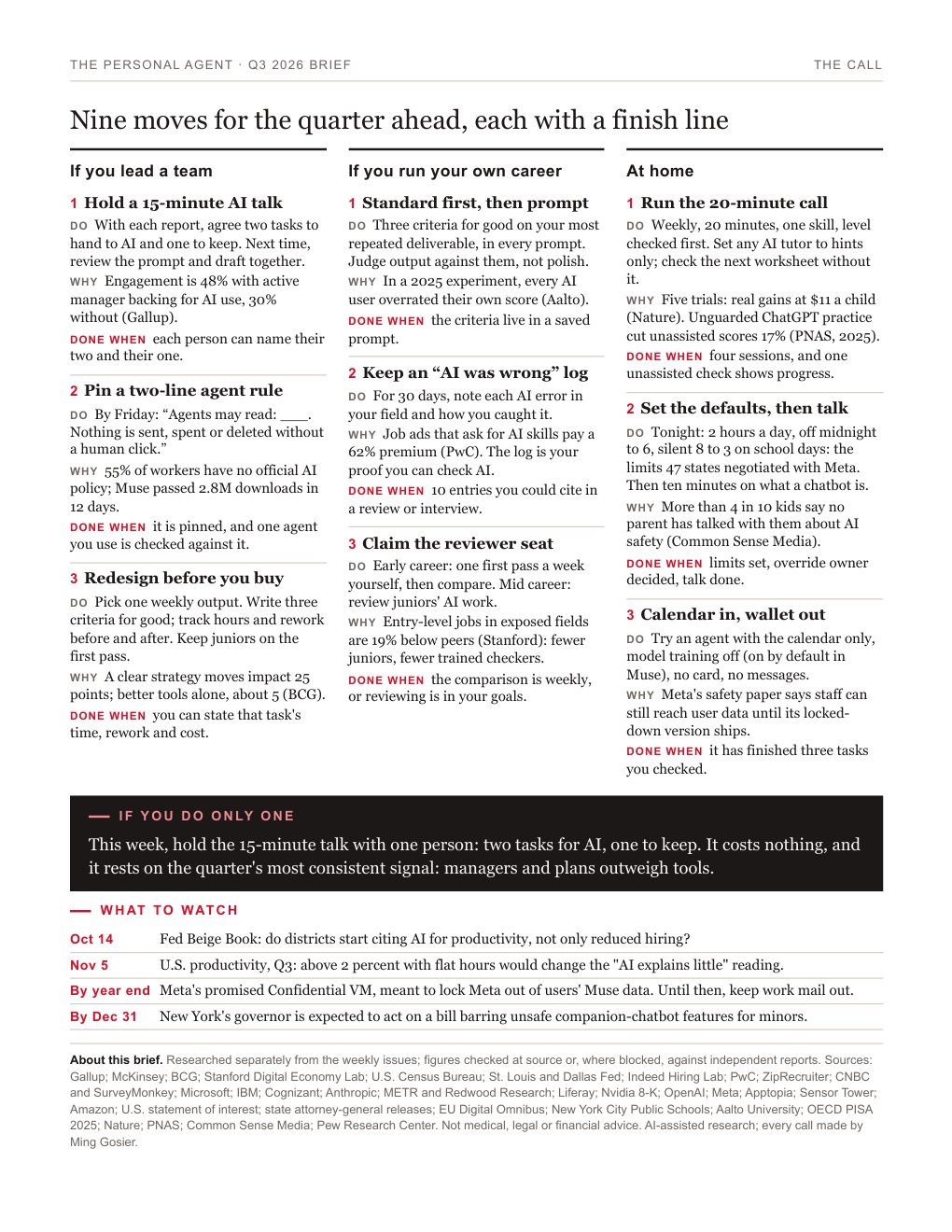
Nine moves for the quarter ahead.
Three for each reader. Each one comes with what to do, why it matters, and how you will know it is done.
If you lead a team
01Hold a 15-minute AI talk
DoWith each report, agree two tasks to hand to AI and one to keep. Next time, review the prompt and draft together.
WhyEngagement is 48% with active manager backing for AI use, 30% without (Gallup).
Done wheneach person can name their two and their one.
02Pin a two-line agent rule
DoBy Friday: “Agents may read: ___. Nothing is sent, spent or deleted without a human click.”
Why55% of workers have no official AI policy; Muse passed 2.8M downloads in 12 days.
Done whenit is pinned, and one agent you use is checked against it.
03Redesign before you buy
DoPick one weekly output. Write three criteria for good; track hours and rework before and after. Keep juniors on the first pass.
WhyA clear strategy moves impact 25 points; better tools alone, about 5 (BCG).
Done whenyou can state that task's time, rework and cost.
If you run your own career
01Standard first, then prompt
DoThree criteria for good on your most repeated deliverable, in every prompt. Judge output against them, not polish.
WhyIn a 2025 experiment, every AI user overrated their own score (Aalto).
Done whenthe criteria live in a saved prompt.
02Keep an “AI was wrong” log
DoFor 30 days, note each AI error in your field and how you caught it.
WhyJob ads that ask for AI skills pay a 62% premium (PwC). The log is your proof you can check AI.
Done when10 entries you could cite in a review or interview.
03Claim the reviewer seat
DoEarly career: one first pass a week yourself, then compare. Mid career: review juniors' AI work.
WhyEntry-level jobs in exposed fields are 19% below peers (Stanford): fewer juniors, fewer trained checkers.
Done whenthe comparison is weekly, or reviewing is in your goals.
At home
01Run the 20-minute call
DoWeekly, 20 minutes, one skill, level checked first. Set any AI tutor to hints only; check the next worksheet without it.
WhyFive trials: real gains at $11 a child (Nature). Unguarded ChatGPT practice cut unassisted scores 17% (PNAS, 2025).
Done whenfour sessions, and one unassisted check shows progress.
02Set the defaults, then talk
DoTonight: 2 hours a day, off midnight to 6, silent 8 to 3 on school days: the limits 47 states negotiated with Meta. Then ten minutes on what a chatbot is.
WhyMore than 4 in 10 kids say no parent has talked with them about AI safety (Common Sense Media).
Done whenlimits set, override owner decided, talk done.
03Calendar in, wallet out
DoTry an agent with the calendar only, model training off (on by default in Muse), no card, no messages.
WhyMeta's safety paper says staff can still reach user data until its locked-down version ships.
Done whenit has finished three tasks you checked.
This week, hold the 15-minute talk with one person: two tasks for AI, one to keep. It costs nothing, and it rests on the quarter's most consistent signal: managers and plans outweigh tools.
Four dates that will test these findings.
- October 14Fed Beige Book: do districts start citing AI for productivity, not only for reduced hiring?
- November 5U.S. productivity for Q3: a reading above 2 percent with flat hours would change the "AI explains little" reading.
- By year endMeta's promised Confidential VM, meant to lock Meta itself out of users' Muse data. Until it ships, keep work mail out.
- By December 31New York's governor is expected to act on a bill barring unsafe companion-chatbot features for minors.
Know someone deciding these things by default?
Send them the brief. It is free, it is three pages, and it will still be at this address next year.
Permanent address: truefulfillmentcoaching.com/newsletter/quarterly/q3-2026
One brief a quarter. One issue a week.
The Personal Agent arrives every Sunday by email: the week's AI news, cut to what matters for your work and your family. Seven minutes, free.
How this brief was made. Four research streams (work, careers, systems, home) went back to the original studies, filings and surveys behind the quarter's AI news. Every figure was checked at its original source or, where the source blocked access, against independent reports, and included only if it held; download estimates are third-party estimates and are labelled as such. Drafted with the editor's AI pipeline; every claim checked and every call made by Ming Gosier.
Sources. Gallup; McKinsey; BCG; Stanford Digital Economy Lab; U.S. Census Bureau; St. Louis and Dallas Fed; Indeed Hiring Lab; PwC; ZipRecruiter; CNBC and SurveyMonkey; Microsoft; IBM; Cognizant; Anthropic; METR and Redwood Research; Liferay; Nvidia 8-K; OpenAI; Meta; Apptopia; Sensor Tower; Amazon; U.S. statement of interest; state attorney-general releases; EU Digital Omnibus; New York City Public Schools; OECD PISA 2025; Nature; PNAS; Common Sense Media; Pew Research Center. Not medical, legal or financial advice.