South Florida · Working with clients worldwide ← Back to the practice
Ming Gosier
Deep inner clarity. An AI-enabled system that cuts the noise. A life that feels deeply human.
Notes · From LinkedIn

What I've been writing.

My LinkedIn posts, kept here, each with a note on the thinking behind it. On coaching, careers, the inner critic, and building personal AI systems.

Follow Along on LinkedIn
September 22, 2026

PM hiring has become an evidence problem.

The thought behind it

Every candidate at the Leland panel was asking how to get hired. The better question is what you can show. The Evidence Ladder is how I answer it now: four rungs, and the higher you climb, the less a hiring manager has to take on faith.

Product management is not dead. But the evidence required to get hired has changed.

In July, I joined PMs from Visa and Shopify for a Leland panel on breaking into product. More than 500 people registered. The questions sounded a lot like the ones candidates asked a decade ago. My answers would be very different today.

Three things have changed. A polished résumé is table stakes, not proof. AI fluency is rapidly becoming baseline. And “Product Manager” by itself is becoming weaker positioning as companies hire around specific domains, problems, and specialties.

I now use a simple four-rung framework with PM candidates:

Claimed. Translated. Demonstrated. Shipped.

The higher you move, the less a hiring manager has to infer about your ability. That is the real shift.

PM hiring has become an evidence problem.

If you are trying to break into product management, or reposition yourself for your next PM role, ask yourself one question:

What could I show a skeptical hiring manager in ten minutes that proves I can do this job?

That answer tells you your rung.

I work 1:1 with PM candidates on positioning, evidence, portfolio strategy, and the interview story behind the application. If you want help figuring out what you should build next, DM me “RUNG.”
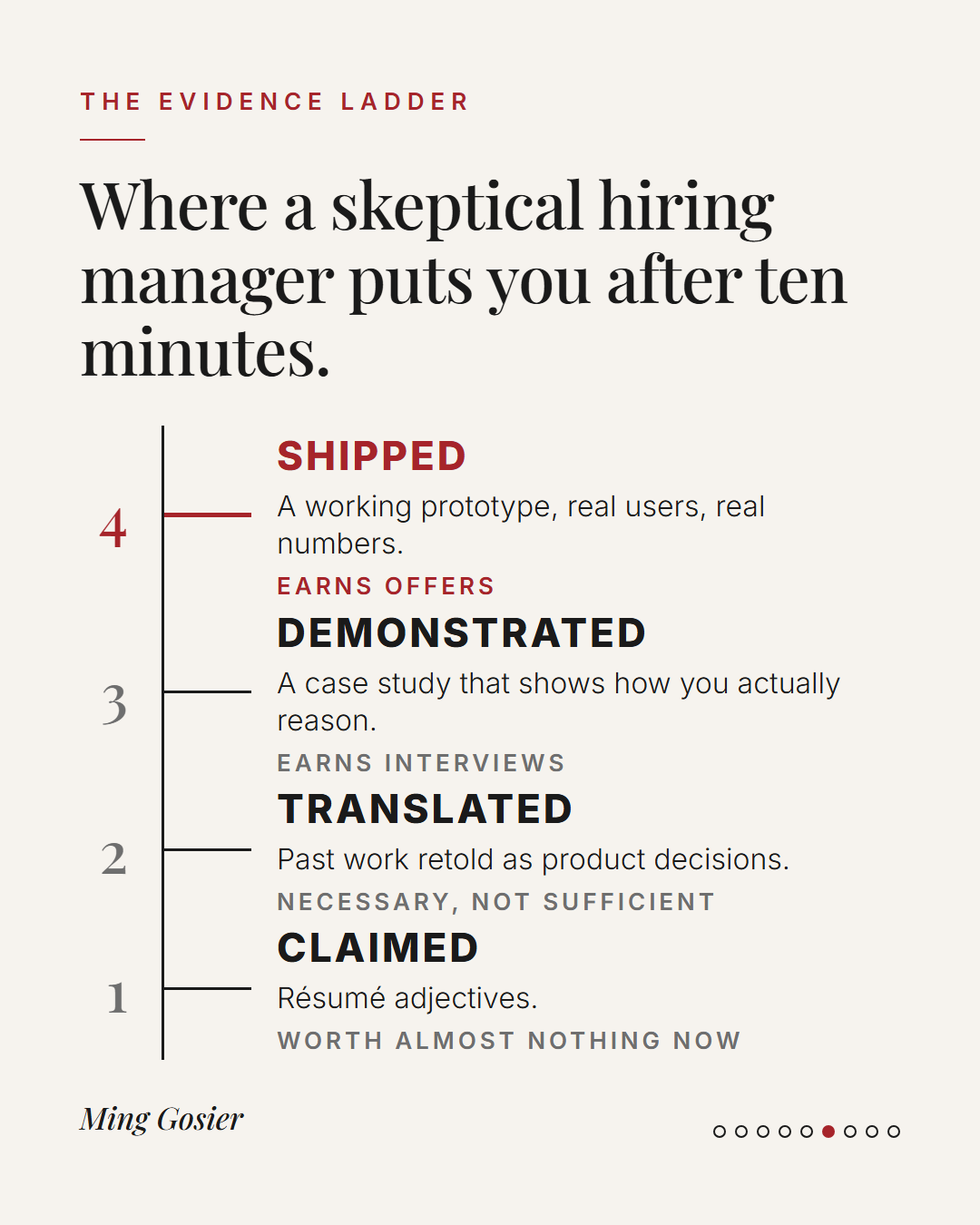
The Evidence Ladder: four rungs a hiring manager reads. 1 Claimed, résumé adjectives, worth almost nothing now. 2 Translated, past work retold as product decisions, necessary but not sufficient. 3 Demonstrated, a case study that shows how you reason, earns interviews. 4 Shipped, a working prototype with real users and real numbers, earns offers. Join the discussion on LinkedIn → Read as its own page →
September 17, 2026 · Leadership Series, Part 3

Using AI at level one. Worrying about it at level three.

The thought behind it

The last part of my three-part series on Prediction Machines. The ladder gave me words for something I kept seeing with leaders: the anxiety lives at level three while the daily use is still at level one. The carousel with the three diagnostic questions is on the LinkedIn post.

Most leaders I meet are using AI at level one and worrying about it at level three.

Level 1 uses AI to do the same job faster. Level 2 lets predictions change real decisions. Level 3 redesigns the work itself, because prediction is now cheap.

Prediction Machines closes with this ladder, and it is the most useful lens I have found for the “what is our AI strategy” conversation. Most organizations, and most careers, are camped at level 1. The compounding gains live higher up.

The climb is not technical. Slide 7 gives you the three questions that find your team’s level in one leadership meeting. Slide 8 is my own answer: what I rebuilt in my coaching practice, and what I refused to hand over.

Final part of my three-part series on the book. If you are rethinking what your role becomes in the AI era, my door is open.

Join the discussion on LinkedIn → Read as its own page →
August 27, 2026

2023 rewarded better prompts. 2026 rewards better systems.

The thought behind it

People keep being handed a 22-buzzword vocabulary list and told it is the future. The map I actually build with has five layers, and the hardest one is not technical. It is deciding what the system may do alone and what stays human.

The builder stack I use now has five layers:

Context. Capability. Orchestration. Trust. Economics.

The hardest one is trust.

What can the system do on its own? Where does a human still need to decide?

That is not an engineering question. It is a leadership question.

Save the map. Then tell me: which layer are you building right now?

Join the discussion on LinkedIn → Read as its own page →
August 25, 2026

"My age will decide for me."

The thought behind it

For every mid-career professional who has been told to reinvent themselves: the move is not reinvention. It is compounding: building the new on top of everything you already know.

Stay, and go obsolete. Retrain, and compete with people half your age. Move up, and hope nobody checks your resume dates.

A client in her fifties put those three options on the table and said, "My age will decide for me."

She is a veteran data programmer, decades deep in a legacy analytics language. Every option on her list asked her to shrink.

The standard advice made it worse. Learn another programming language. Get the next certification. Start over at the bottom of someone else's ladder, at fifty.

We threw that plan out.

Twenty years of analytics judgment is not a liability to explain away. It is the one asset the market cannot train fast.

So the move was not reinvention. It was compounding. Building the new on top of everything she already knew.

Because her value was never the code. Her value is the judgment wrapped around it.

AI can now handle the routine layers underneath all of that. Which does not shrink her role. It promotes her, from running the analysis to directing it.

Ageism argues with your birth year. You will not win that argument.

But relevance is not an age. It is a position. And a position is something you can choose.

So the question is not "will AI replace me?" It is "what could I build if AI sat on top of everything I already know?"

What would compounding look like in your career?

Join the discussion on LinkedIn → Read as its own page →
August 20, 2026

Working fewer hours made me more ambitious.

The thought behind it

The result I least expected from building my own AI team: the return was not productivity. It was ambition, and the idle time for ideas to connect.

I did not expect that.

Over the past few months, a team of AI agents has taken over the work that drains attention without needing anything uniquely human from me. The remembering, the collecting, the organizing, the formatting.

The work that actually needs me stayed mine. The thinking. The coaching. The deciding. Being present with another human being.

I expected a tidier task list. What I got instead was idle time. Time to think. Time to let ideas connect. Time to follow curiosity without asking whether it is "productive."

And that space did something strange: it made me want to build more, not less.

I am testing ideas I never had the capacity to try. New channels. New experiments. More places for my ambition to go, without giving it more hours of my life.

That is what excites me most about AI. Not squeezing 20 percent more work out of the same day. Lowering the cost of creating something new. When research, preparation, and routine execution get dramatically lighter, an idea that once felt too expensive to pursue becomes possible.

I used to end the day with my ambition intact but my attention spent. Too often, the people I loved got whatever energy was left. I do not want to build that way anymore.

Ambition without burnout is not wanting less. It is designing your life so that what you want costs less to pursue.

If you are running on empty, maybe the question is not "What should I give up?" Maybe it is "What am I still carrying that no longer needs to be carried by me?"

What is one part of your week you would gladly hand to an AI agent, if you knew it could handle it well?

Join the discussion on LinkedIn → Read as its own page →
August 18, 2026

Ambition is not what burns people out.

The thought behind it

The distinction I come back to most often in sessions: ambition asks "What am I building?" The inner critic asks "Am I good enough?" One question generates energy. The other leaks it.

You cut the goal. You took the break. You came back just as tired.

Almost every high-achieving professional I coach has already tried that. Rest fixes tired. It does not touch this.

Because ambition was never the thing draining them.

Ambition asks, "What am I building?" The inner critic asks, "Am I good enough?"

The first question generates energy. The second one leaks it, because it points at a verdict that never arrives.

That is why cutting your goals so rarely helps. You cut the thing that was giving you energy and keep the thing that was draining it.

The shift is smaller than it sounds.

Notice the sentence. Not the mood, the actual sentence in your head. Write it down word for word.

Then ask it one question: what would finished look like?

Ambition can answer. It names a target, a date, a done. The critic cannot, because it was never asking about the work. It was asking about you.

When you cannot fill in "done means ___," you have found the voice that is costing you your evenings.

You do not have to want less. You have to stop letting the judge set the pace.

Whose voice sets the pace of your week, your ambition or your critic?

Join the discussion on LinkedIn → Read as its own page →
August 13, 2026

The college consultant I didn't hire.

The thought behind it

I built this for my own family before I ever wrote about it. It is still the clearest example I have of what a personal agent should be: private, local, and quietly useful.

The college consulting quote I saw: $50,000 a year. Starting in 9th grade.

I understand the fear underneath that number. What if my child has a strength I am not seeing, and I notice it too late?

But I could not justify the price. And I kept coming back to one belief: nobody knows my children better than I do. What I was missing was not a consultant. It was a way to see the whole picture.

So I built a private education advisor agent instead.

It runs on my laptop. Everything goes into one place: academics, activities, passions, the small moments that show character. Each quarter it reads the whole record the way an experienced counselor would and briefs me.

It catches what I cannot see on my own: the quiet slide hiding under a straight-A report card. The same strength showing up in three different places. Confidence growing. Leadership starting. The blind spots a busy parent misses, flagged while there is still time to act.

Privacy was the first design decision, not an afterthought. Everything stays on my laptop. No apps. No cloud. My kids never touch it. It cannot email a teacher or make a single decision. It watches, it briefs, I decide.

The consulting industry sells an earlier start in the arms race. I wanted the opposite: less anxiety, a fuller picture, and parenting that stays human.

If a private advisor watched for your child's hidden strengths, what would you want it to notice first?

Join the discussion on LinkedIn → Read as its own page →
August 11, 2026 · The Relaunch

The other half of fulfillment.

The thought behind it

This is the post where I said the quiet part out loud: after 500+ hours of coaching, I believe inner clarity is only half of what my clients need. Publishing it made the relaunch real.

After 500+ hours of coaching, I've come to believe that inner clarity is only half of fulfillment.

Today, I'm launching the other half.

The inner work still matters deeply. Your values. Your strengths. Your boundaries. Your own definition of success. That's the foundation of a career, and a life, that feels truly yours.

But here's what I kept noticing with my clients: clarity doesn't always survive Monday.

The inbox fills up. The calendar gets messy. School messages arrive. Small tasks pile up. Expectations at work keep rising, and decisions need to be made faster than ever. Before long, your mental space is gone.

So last year, I started building a fix, for myself first. Using agentic AI, I built my personal AI team to help automate parts of my work and my family life.

The surprise wasn't the productivity. It was the mental energy I got back. More room to think clearly. More capacity to be present. More space to decide what actually deserves my attention.

That's why I'm relaunching my practice around one simple idea:

True Fulfillment = Inner Clarity + an Effective Outer System

I now help high-achieving professionals do both: get clear on what truly matters, then build personalized AI systems around your work and life, with no technical background needed.

Not so AI can run your life. The opposite. So AI absorbs the noise, and you protect what should stay deeply human: thinking, creating, connecting, making career decisions you won't regret, being present with the people you love.

Read as its own page → Join the discussion on LinkedIn →
Keep Reading

New notes land here after every post.

Follow on LinkedIn for the discussion, or start a private conversation about your own clarity and systems.