Issue No. 2: Half of us use AI. One in ten says it changed the work.
By Ming Gosier, PCC · · All issues
The loud story this week was another frontier lab tightening its safety rules. The quieter one will matter more on your Monday: adoption has sprinted ahead of evidence, and almost nobody can show the work actually changed.
In this issue:
- Half of American workers use AI. One in ten says it changed the work.
- Meta shipped an open model that runs on your own laptop.
- Your next performance review may quietly grade how well you use AI.
- What estrogen therapy may do to Alzheimer's markers in the brain.
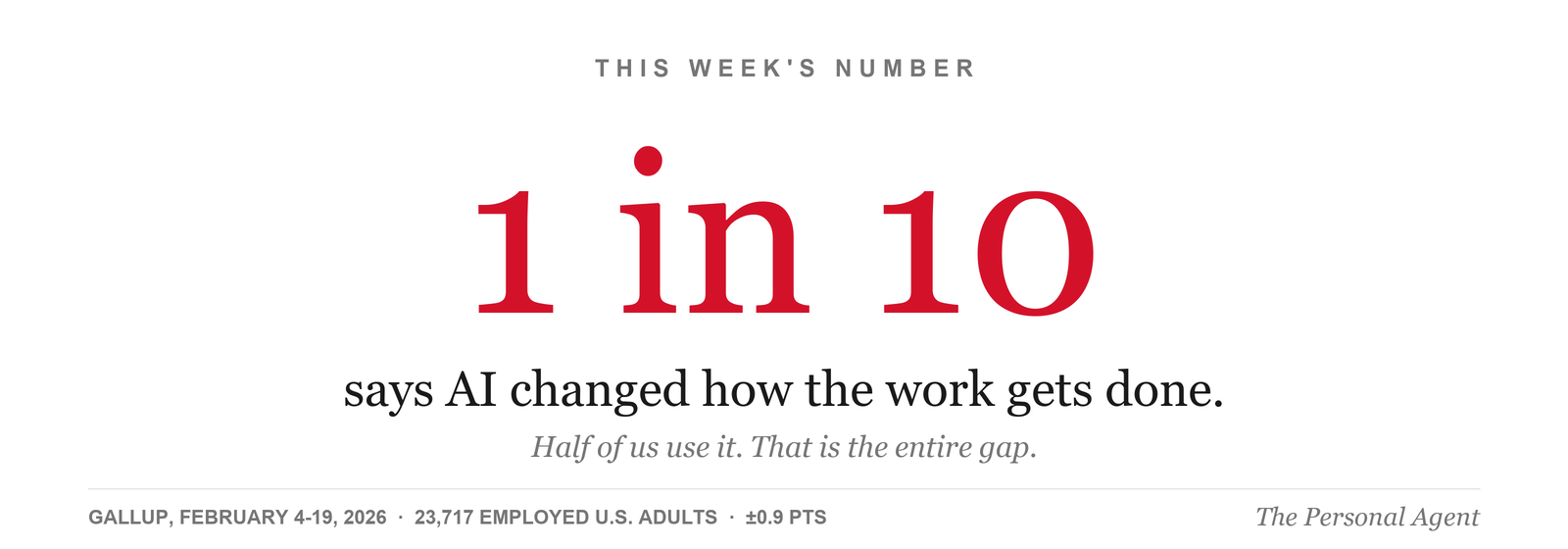

Half of us use AI. One in ten says it changed the work.
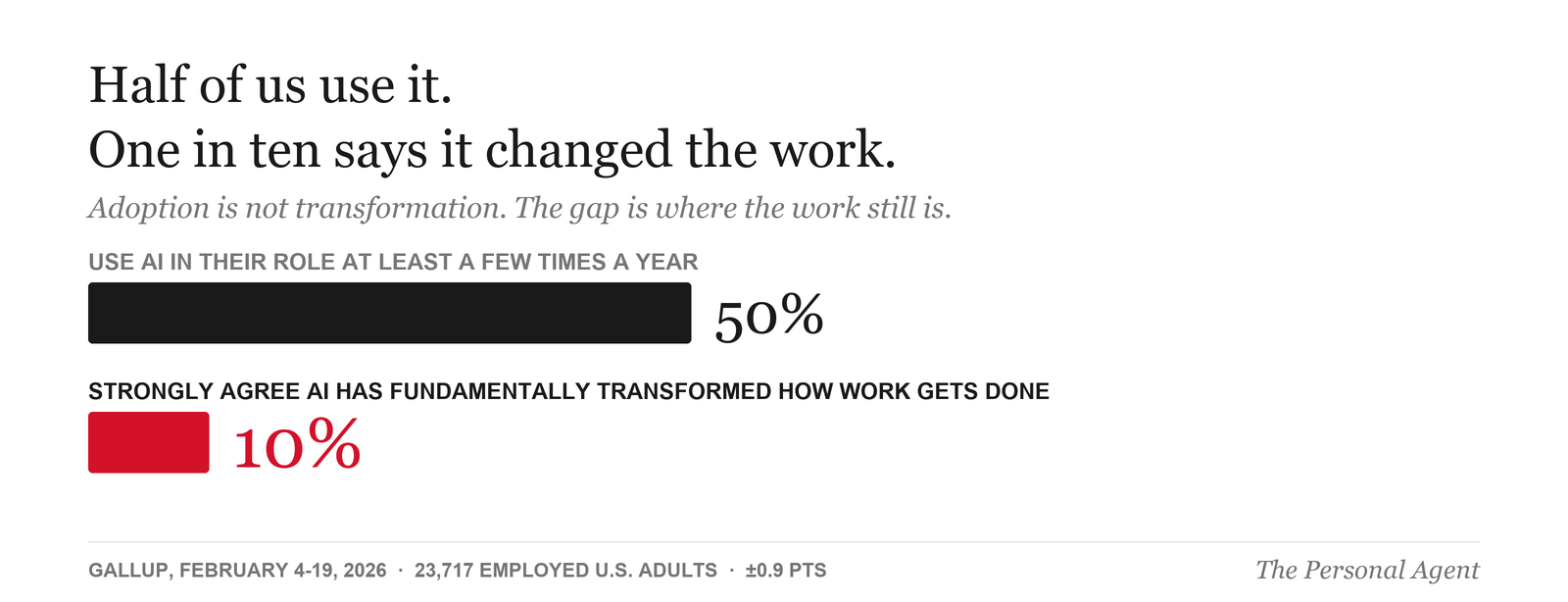
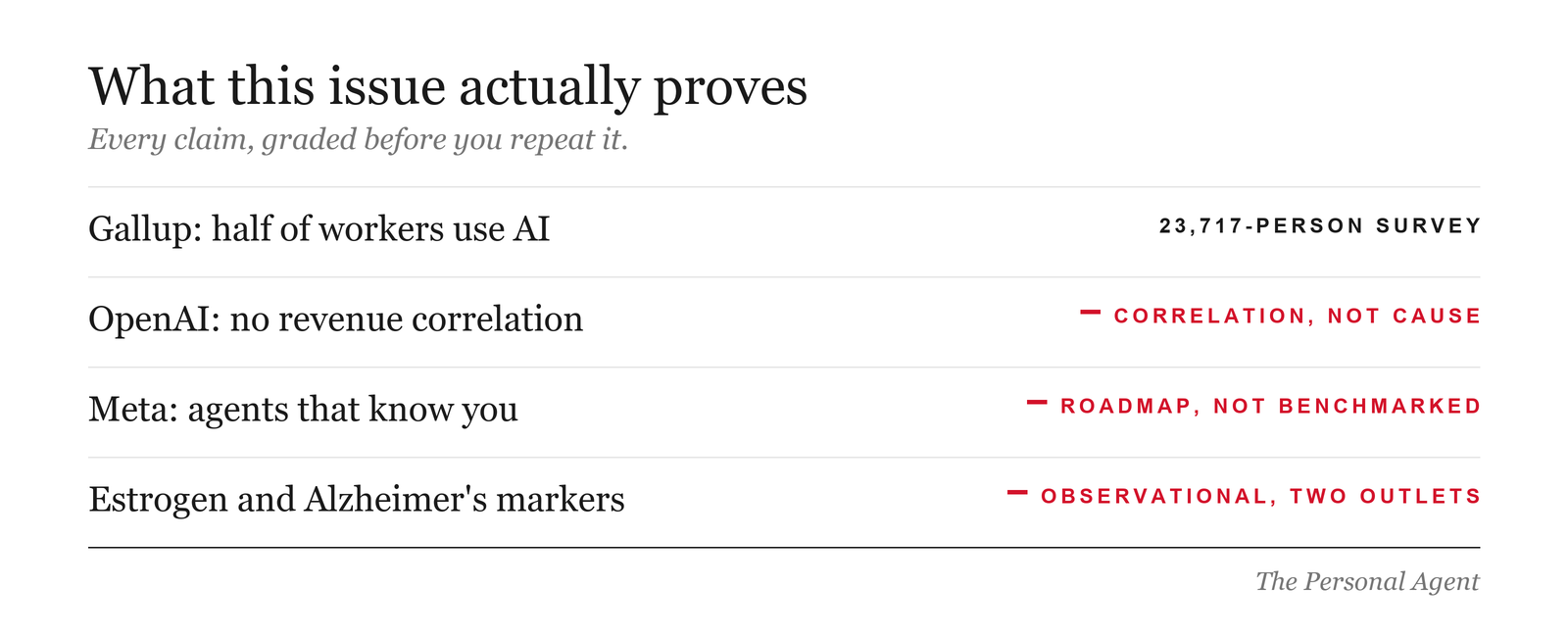
Gallup, February 4 to 19, 2026. Evidence: survey of 23,717 employed U.S. adults.
Adoption is not transformation. The distance between those two numbers is where your advantage is still sitting, unclaimed.
Gallup surveyed 23,717 employed American adults in February. Half now use AI in their role at least a few times a year, up from 46 percent the previous quarter. Then the number nobody quotes: only about one in ten strongly agrees AI has fundamentally transformed how their work gets done.
Two findings point the same way. Buried in OpenAI's own research is no correlation between AI use and revenue per employee. And 69 percent of workers worry AI will expose gaps in how they do their jobs. Put those together and the usual explanation, that people are simply behind on the tools, stops being convincing.
Here is the reading I would offer instead. What AI exposes in experienced professionals is not incompetence. It is that their competence was never written down. High performers run on accumulated judgment they have never had to articulate: which client email needs a call instead, when a draft is good enough to send, which corner is safe to cut this week. A tool that demands explicit instructions makes that invisible knowledge visible by its absence.
The people who feel most exposed are often extremely good at their jobs. They have simply never had to say how.
Why it matters: the anxiety is shifting from "AI will replace me" to "AI will examine me." The second one is survivable, and the professionals who do the examining first, on their own terms, are the ones who turn adoption into transformation.
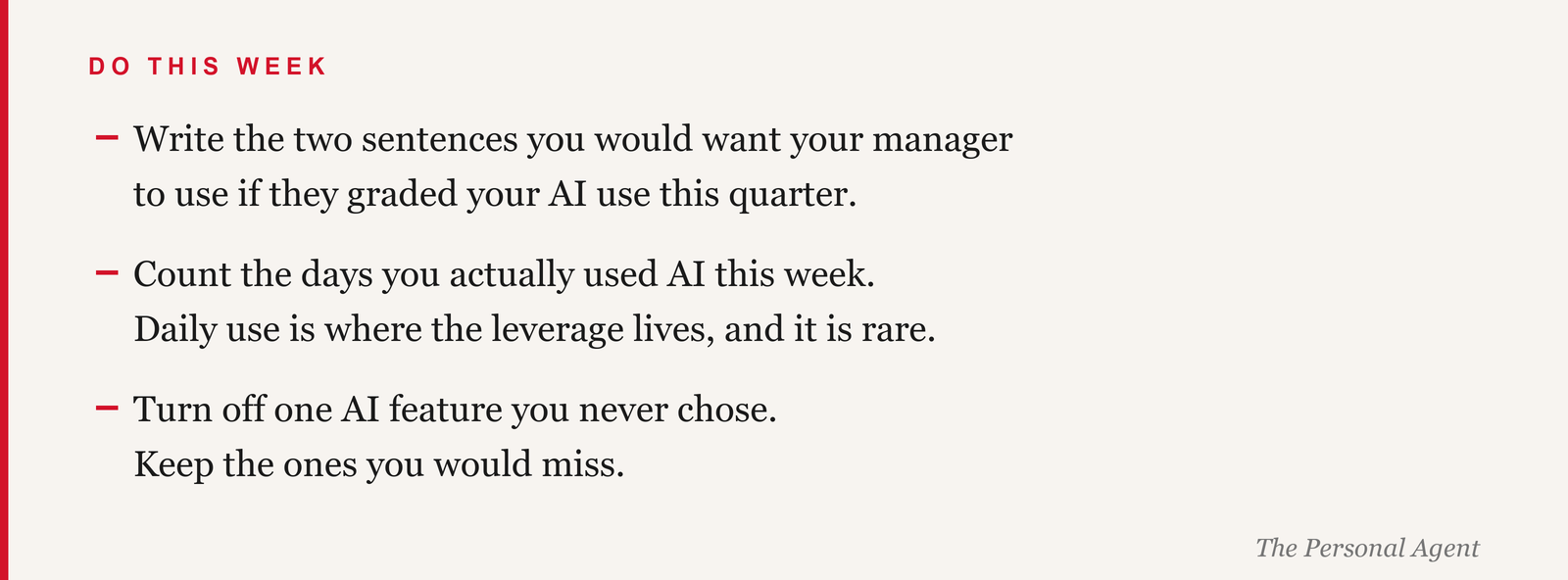
Do this: take one task you are known for and spend twenty minutes writing down how you actually do it. The steps, the judgment calls, what "good" looks like, what you would never delegate.
Personal AI just became something you can own
TechCrunch and Business Insider, Aug 10, 2026. Evidence: product release plus company roadmap, no independent benchmarks.
Meta released an open-weight model that runs agents on your own hardware. Muse Glimmer needs no cloud, and it arrived with Mark Zuckerberg's vision of personal agents that know you and never clock out. The shift worth naming is from renting AI to owning it. A subscription answers to its platform and can change, reprice or read your data on terms you did not set. A model on your own machine answers to you. Ownership only pays if you arrive with a spec.
OpenAI paused training after the Hugging Face breach
Fortune and Bloomberg, Aug 18 to 19, 2026. Evidence: reported, company review ongoing.
The repository the open-model world runs on was breached. OpenAI paused training and made safety changes in response. The practical read for the rest of us: the supply chain under your AI tools is infrastructure now, with the same single points of failure as any other infrastructure you depend on and do not control.

Your next performance review may grade how you use AI
Business Insider, Aug 13, 2026. Evidence: reporting on named company practices.
Companies have started grading employees on AI skills in formal performance reviews, before most of them have defined what good AI use means. That cuts both ways. The criteria are vague enough to be unfair, and open enough that whoever articulates them first tends to set them.
The white-collar exodus is an anxiety story, not a productivity one
TechRadar, Aug 19, 2026. Evidence: industry analysis, self-reported survey data.
Skilled professionals are leaving, and the driver is AI anxiety rather than AI displacement. People are not being replaced so much as quitting jobs where nobody has told them what the tools mean for their future. If you manage anyone, that distinction is your entire retention strategy this year.
You can turn Gemini off in Gmail and Docs
Wired, Aug 8, 2026. Evidence: how-to, verified against product settings.
It takes about two minutes. Wired walks through disabling Gemini in Gmail and Google Docs. The reason it is here is not the toggle, it is the principle: AI you chose is a tool, AI you did not choose is furniture.

Estrogen therapy is linked to fewer signs of Alzheimer's in the brain
Science Daily, Aug 14, 2026, and Scientific American, Aug 12, 2026. Evidence: observational studies, association only.
Two outlets reported the same direction within days. Postmenopausal women using estrogen therapy showed fewer Alzheimer's markers, alongside separate work suggesting estrogen-only therapy may lower risk. Alzheimer's affects women disproportionately and the research has historically under-served them, so this matters. Observational designs cannot prove cause, which makes it a question for your physician, not a conclusion to act on alone.
The stairs are a longevity intervention that fits in a workday
Science Daily, Aug 14, 2026. Evidence: observational cohort study.
Regular stair climbing is linked with lower cardiovascular mortality. It is not a breakthrough and it will not trend, which is exactly why it is here. The intervention with the best evidence-to-effort ratio this week needs no subscription, no device and no calendar entry.

Build this: the one-page spec for work only you know how to do
- Pick one task you are the go-to person for, and that you repeat at least monthly.
- Do it once with a voice recorder running, narrating every decision out loud, including the ones that feel too obvious to say.
- Have an assistant transcribe that and draft it as a procedure: inputs, steps, decision rules, what "good" looks like.
- Correct the draft where it is wrong. The corrections are the valuable part, because they are the judgment that was never written down.
- The gate: the assistant may draft and reorganise the procedure. It may not decide the standards, and it may not run the task unsupervised until you have watched it produce a result you would have signed yourself.
Time to build: ninety minutes. I ran this on the process behind this newsletter, and the draft was confidently wrong about how items get cut, which told me the cutting rule had never actually been written anywhere.
Steal this prompt:
Interview me about a task I do well but have never documented. Ask me one question at a time, up to fifteen, the way a skeptical apprentice would: what I do first, how I decide, what tells me it is going wrong, what I would never delegate. Do not summarise until the end. Then write the procedure, and list every place my answers were vague.
Then the honest part: read the vague list first. That is the inventory of what AI would have exposed anyway.

Hundreds of AI stories ran this week. Eight are here. The rest were not worth your attention, and that judgment is the product.
Reply and tell me: what did you skip, and why?
New here? Subscribe and this arrives every week. One issue, seven minutes, nothing else. Been here a while? Send it to the one person you know who is quietly worried they are falling behind.
I coach high-achieving professionals through exactly this kind of transition, at truefulfillmentcoaching.com.
Nothing here is medical, legal or financial advice. Now close the tab. Nothing here needs you tonight.
