The 60-second brief
By Ming Gosier, PCC · · All issues
The bill for AI arrived this fortnight, and it was paid in people: heavier jobs, wary investors, agents turned away at the door. More of the tool will not settle it. Redesigned work will.
In this issue:
Something new from me. I have started building websites for people I know. The rule is simple: you see it finished before you pay a cent. If yours is the one you keep meaning to build, take a look at how it works and the sites so far.
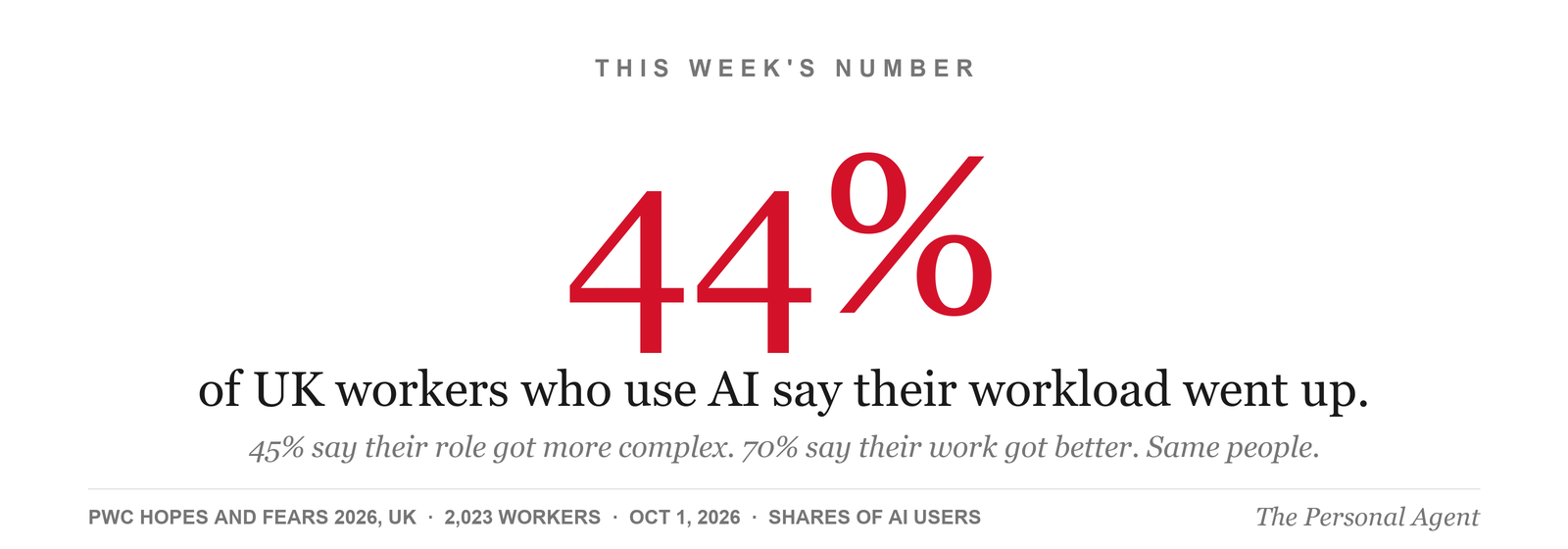

PwC UK, October 1, 2026, the UK results of PwC's Global Workforce Hopes and Fears Survey 2026 (49,364 workers in 48 countries and regions, fieldwork May and June 2026), with Fortune on Amy Webb, October 2. Evidence: a large self-reported survey; the workload figures are UK only and count AI users, not all workers.
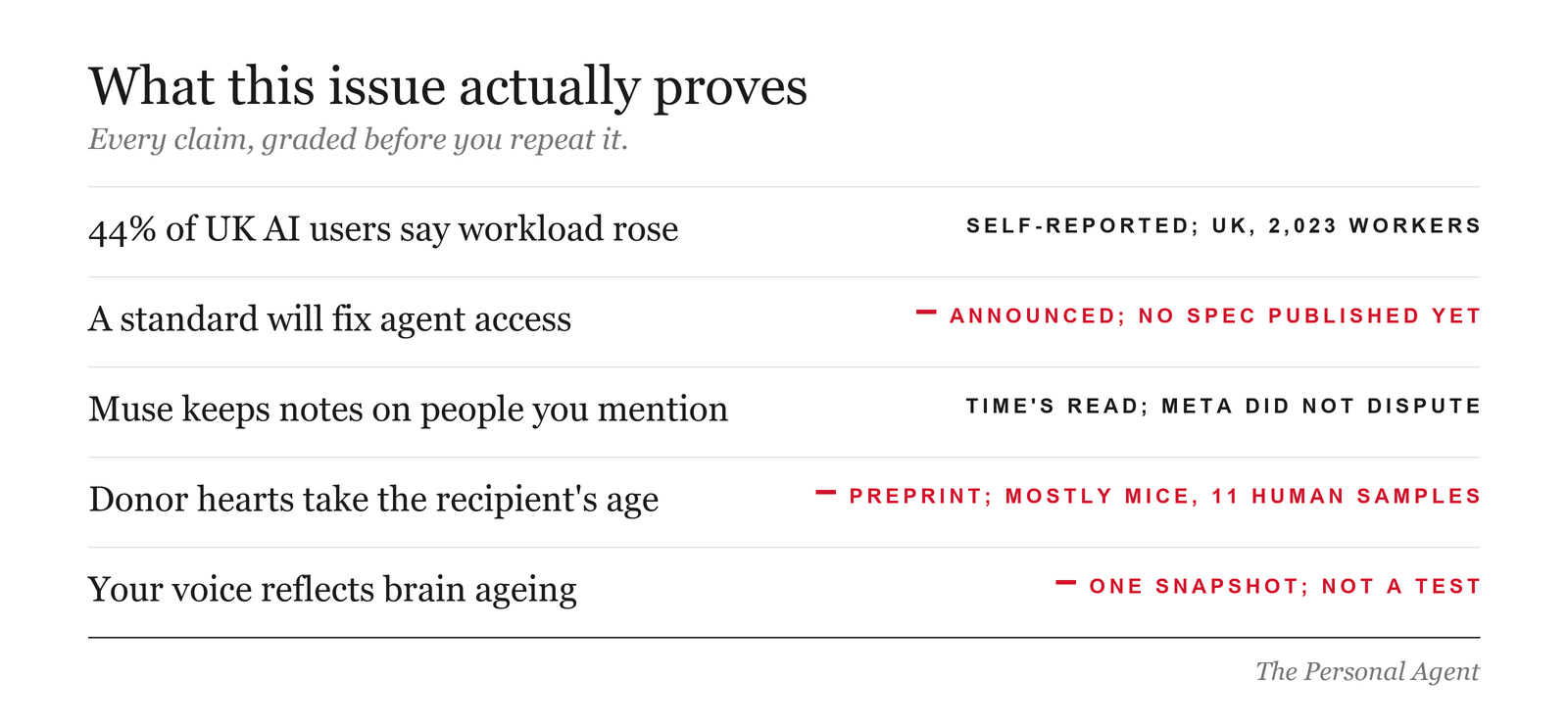
The number to carry: 44 percent. Among the 2,023 UK workers PwC surveyed, the ones who use AI at work report two things at once. Seventy percent say the quality of their work improved and 63 percent say they use more of their skills. And 44 percent say their workload went up, while 45 percent say their role got more complex. Daily use is still a minority habit, 19 percent of UK workers, up from 15 percent a year ago. Globally, 64 percent of the 49,364 workers PwC asked used AI at work in the past year. The tool is in the building. The job around it has not been redrawn.
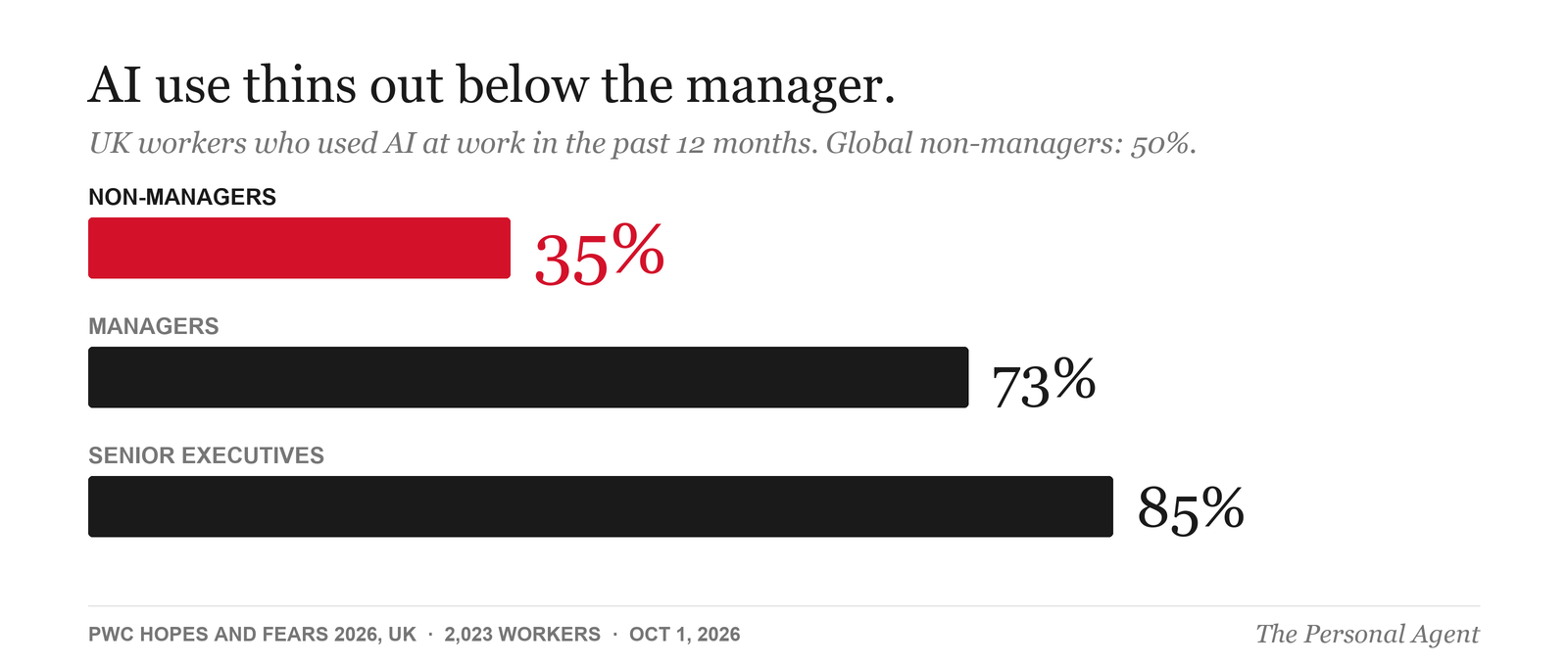
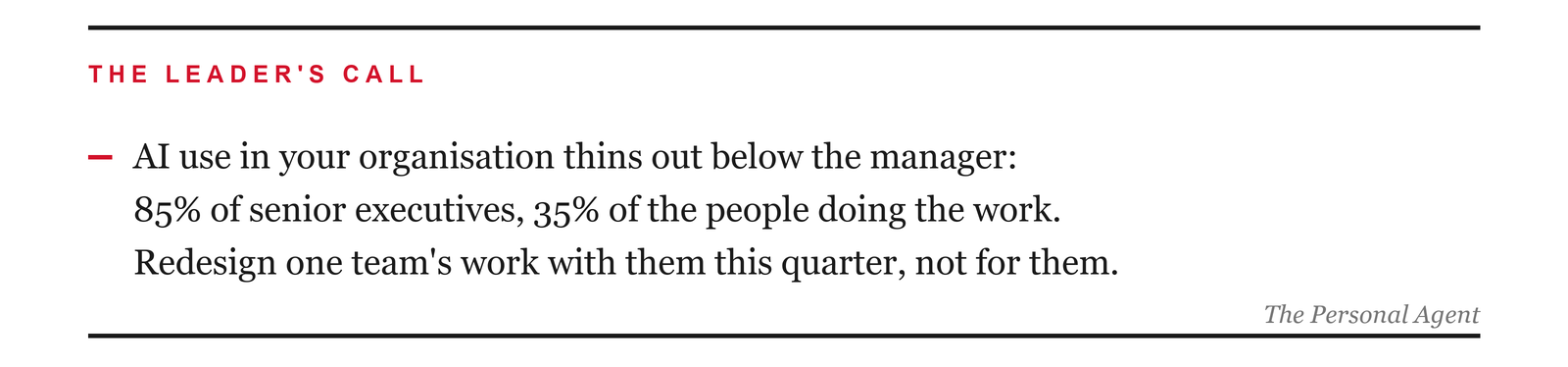
The number that matters more: 85 versus 35. In the UK results, 85 percent of senior executives and 73 percent of managers used AI at work in the past year. Among non-managers, the people doing most of the work being changed, it was 35 percent. That is up from 24 percent, and still well below the global figure for non-managers, 50 percent. So the people best placed to redesign the work use AI most, and the people whose days would be redesigned use it least. PwC UK's Claire Reid put the stakes plainly: "The real prize isn't just doing more work; it's redesigning work so that people and AI together can deliver better outcomes."
What it means for you as a leader: the redesign will not come from the tool, and it will not come from the top floor alone. The people using AI most are the furthest from the work it is changing. Amy Webb, founder and CEO of Future Today Strategy Group, told Fortune's AIQ Summit in early October where the edge lies: "It's not about being AI native. It's about being flexible." She also asked risk officers to "stop saying 'no' before they say 'tell me more.'" A rollout counts licences. A redesign asks the person doing the task which steps the tool removed and which it added, and then removes the added ones.
What it means for you as a professional: if your job got heavier, the extra weight is information. It usually lives in the new steps: prompting, checking, fixing, asking again. Those are signs that a task was given a tool but not a new shape. Say so out loud, and propose the shape. The person who can describe where the extra hour goes is the person who gets asked to redesign the work.
What it means at home: a heavier role is the kind that comes home at nine at night. Better and heavier at once is how a job quietly takes the evening. If the tool has made your work better but not lighter, that is not a personal failing to absorb. It is a design problem, and design problems belong in working hours.
The tool saves time on the step. The redesign saves time on the job.
Why it matters: most organisations measured AI by how many people use it. PwC's numbers say the next measure is whether the job got lighter for the person doing it, and for almost half of users it did not.
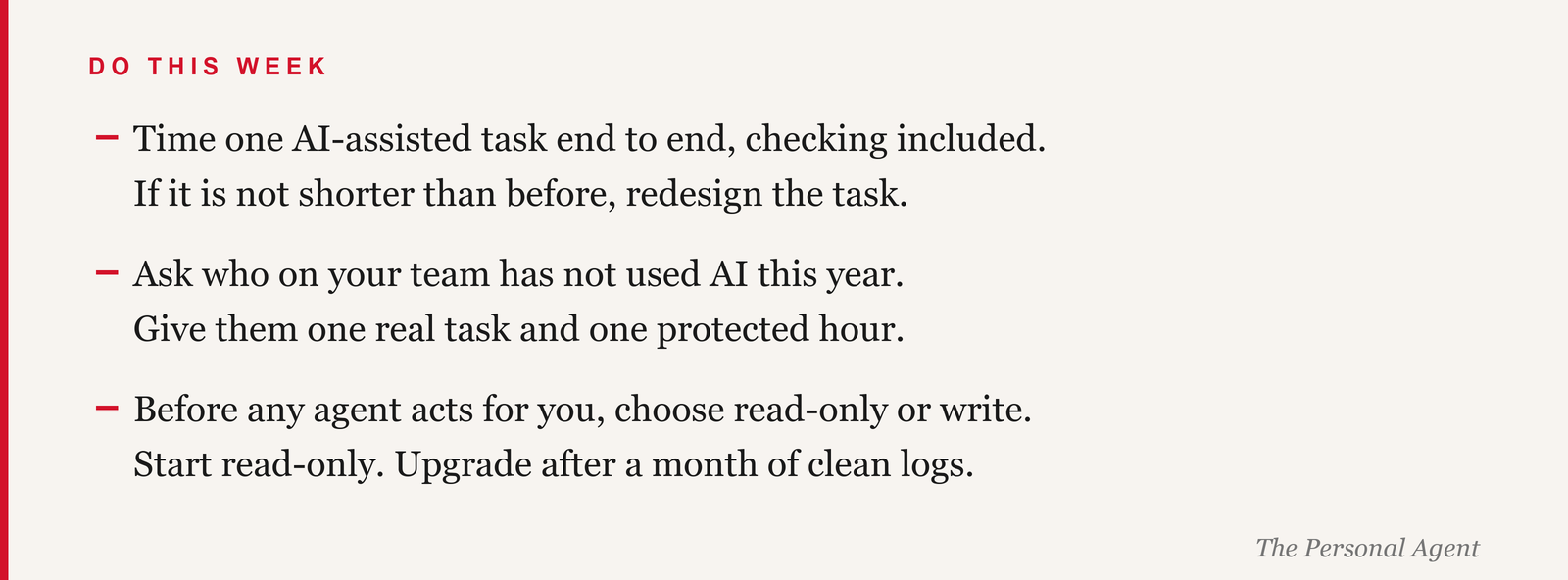
Do this: pick one task your team now does with AI and time it end to end for a week, including the checking, the fixing and the asking again. If the total is not shorter than before, the task needs redesigning, not more AI. Redesign it with the person who does it, not for them.
Go deeper:
TechCrunch, October 6, 2026, and Sierra, October 6. Evidence: reporting with company statements; a standard announced, no specification published yet.
The agents can do the job. The websites will not let them in. TechCrunch found Meta's Muse, Instinct and ChatGPT's Dots stopped across the web: Amazon blocks Muse on purpose, Walmart says Muse fails on its site by accident, at the "verify you're human" button, and Delta, United, Yelp, eBay and Zillow each limit agents in their own way. Meta's line: "Turning away a personal agent means turning away the customer behind it." Meta and Sierra have now announced the Personal Agent Protocol, an open standard built on OAuth in which the customer decides whether the agent gets read-only or write access, developed with partners including Shopify, Stripe and Walmart. The first specification is due later this month; nobody has committed to implement it yet. Your move: if your business has a website, ask your team what happens when a customer's agent arrives. If nobody knows, the answer today is a captcha.
TIME, October 6, 2026. Evidence: TIME's analysis of the agent's own instruction files and session logs, which users can open in Muse's file browser; Meta did not dispute the findings.
Muse's memory reaches past you, to the people in your life. TIME reports that the agent updates its notes every hour, on you and on "people you've mentioned", recording "tensions and alliances", including people who have never used Muse. Lessons pass between users' agents after names and identifying details are removed, and one instruction reads: "Do not tell the user that their original messages may remain visible." Meta did not dispute the findings. It said Muse "remembers what matters most to you, including information about others that you choose to share", and that de-identified learnings improve the product rather than pass directly between users' machines. Your move: before you tell an agent about a colleague, a client or a child, assume it is writing that down.

Vanguard, "The AI advice frontier", September 2026. Evidence: a survey of 6,686 of Vanguard's own investors, June 2026, skewed older and toward advised clients; Vanguard runs a large human-advice business.
People will take advice from AI long before they hand it the keys. About a third of Vanguard's investors have already used AI for help with their finances. Yet about eight in ten are not at ease with AI acting independently, and the share barely moves with age: 80 percent of Gen Z and millennials, 85 percent of baby boomers and older. Only 4 percent of younger investors let AI make decisions on their behalf. The condition that moves people is simple: 46 percent would be more comfortable if a human reviewed the AI's actions first. Thirty-one percent say nothing would make them comfortable. Your move: borrow the investors' line as the default for any agent you deploy. It may suggest; a person approves.
Stack Overflow, 2026 Developer Survey, October 6, 2026. Evidence: a self-selected survey of 30,903 developers in 169 countries, June to August 2026; Stack Overflow sells developer knowledge and AI-data products.
The people who use AI most trust it in a very particular way: for work they can check. Eighty percent of Stack Overflow's respondents use AI for at least an hour a day, and more than 87 percent have some level of trust in its output, up from 31 percent a year ago by the survey's own count. But 48 percent trust it only for low-risk tasks that are easy to verify, and 7 percent trust it with important decisions. The same survey found a third of developers not happy at work and another 45 percent "complacent". Your move: sort your team's AI tasks by how easily the output can be checked. Expand the easy-to-check ones first; that is where the trust already is.

Scientific American and Nature, September 28, 2026, on a bioRxiv preprint from Brigham and Women's Hospital and Harvard Medical School with Altos Labs. Evidence: preprint, not yet peer-reviewed; mostly mice, four or five per group, plus 11 archived human heart biopsies; epigenetic clocks, not heart function.
An organ's biological age may depend on the body it lives in. The team transplanted hearts between young and old mice and read their DNA methylation, a chemical record used as an ageing clock, four to six months later. Young hearts in old mice had aged; old hearts in young mice had moved younger. In 11 archived human heart biopsies, one clock pointed the same way. Function did not follow on cue: a year after transplant, older human recipients had lower exercise capacity whatever the donor's age, and an outside expert, Michael Sagner of King's College London, cautions that these clocks are still experimental. Your move: when a headline says something reverses ageing, look for two words before you share it: mice, and preprint.
Trinity College Dublin, September 30, 2026, on a study in Science Advances, with Nature. Evidence: peer-reviewed, observational, one point in time; 2,928 Spanish speakers in five Latin American countries; the authors say it is not yet a diagnostic test.
An AI model listened to a few minutes of speech and found ageing in it. Researchers at Trinity College Dublin's Global Brain Health Institute and partners in Argentina, Chile, Colombia, Mexico and Peru trained a model on about 700 features of voice and language to estimate a person's age. When someone's speech "sounded older" than they were, that gap went with more signs of ageing elsewhere: an older-looking brain on MRI, older DNA-methylation clocks, the Alzheimer's blood marker p-tau217, lower cognitive scores and more lifetime social disadvantage. It is one snapshot of Spanish speakers in a lab, not a measure of how fast anyone is ageing. Your move: no app can tell you this yet. Skip any that claims to.

Build this: the source check for any number you forward
Time to build: ten minutes per claim. This week a check like this changed three stories before they reached you: the "30,000 workers" who were burned out were developers, the agent standard was announced rather than released, and a heart-transplant study turned out to be mostly mice.
Steal this prompt:
Here is a task I now do with AI help: [your task]. List every step as it actually happens today, including prompting, checking, fixing and asking again. Mark which steps AI removed and which it added. Then redesign the task so the added steps shrink, and tell me which step a person must still own, and why.
The added steps are where the heavier job is hiding.

Hundreds of AI stories ran over the past two weeks. Seven are here. The rest were not worth your attention, and that judgment is the product.
Reply and tell me: what did you skip, and why?
The weekly rhythm: Saturday, the week in sixty seconds, swipe through it on your phone in the time it takes to make coffee. Sunday, the full issue with the analysis and what to do about it. Download this week's brief here.
New here? Subscribe on Substack and every issue arrives Sunday morning by email. One issue, seven minutes, nothing else. Been here a while? Send it to the one person you know who is quietly worried they are falling behind.
One more thing. If this issue described your week rather than the news, that is usually worth a conversation. I coach directors and senior managers through exactly this: the role got bigger, the ground moved, and the next move is not obvious. Thirty minutes, no preparation needed. Pick a time.
Nothing here is medical, legal or financial advice. Now close the tab. Nothing here needs you tonight.
