By Ming Gosier, PCC · · All issues
The 60-second brief
The most useful number this week is not how many people expect AI to take jobs. It is who is least afraid: the people who have read the most about it. Fear of AI is mostly a knowledge gap, and that is the cheapest gap you will ever close.
In this issue:
Reading this on LinkedIn? You can get it direct instead: published every Sunday morning, free.
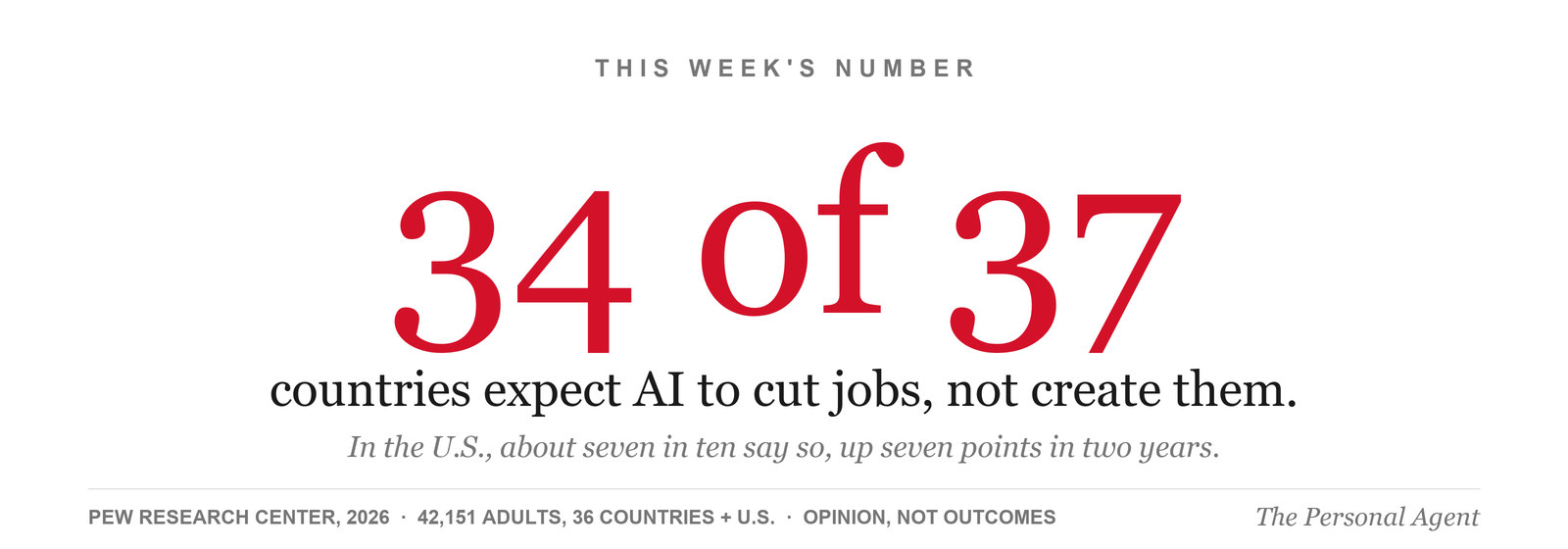

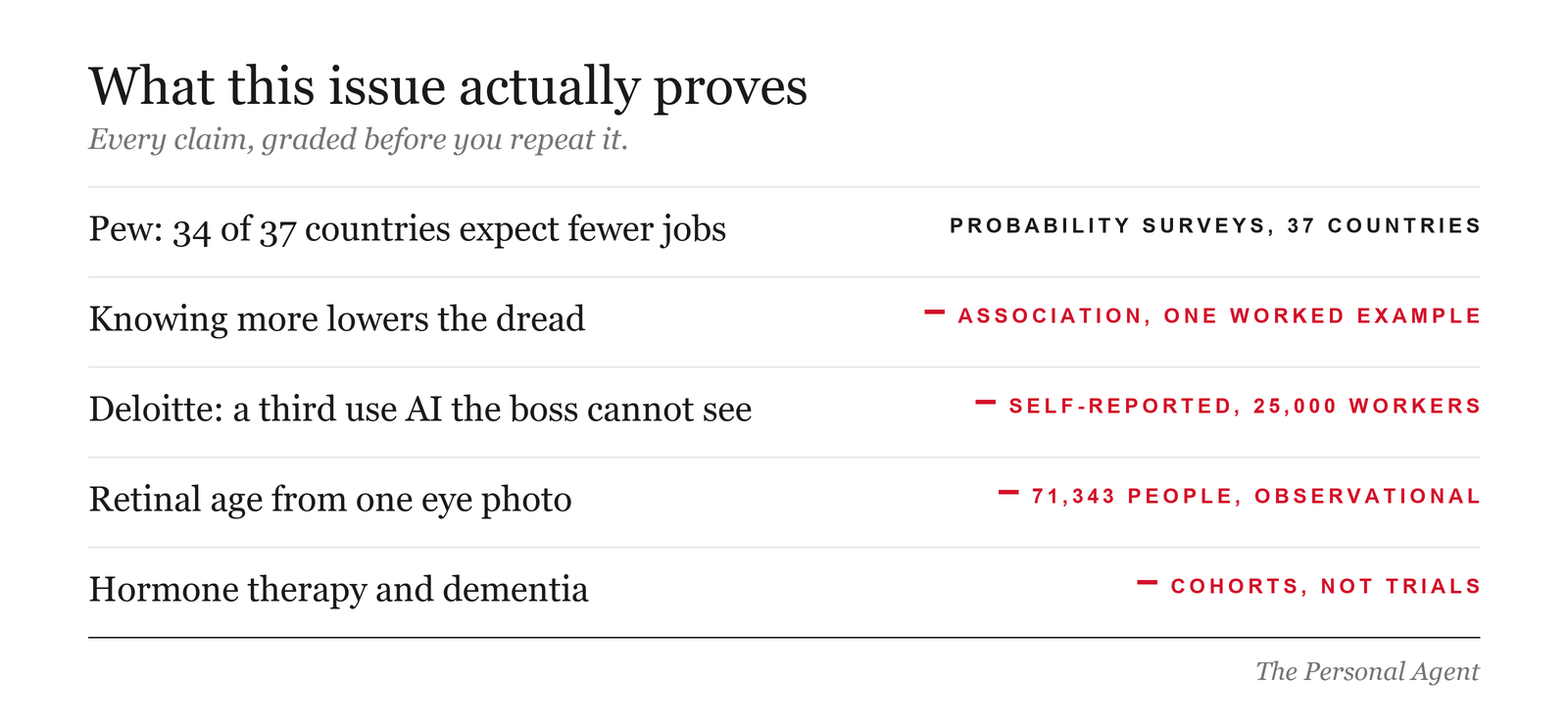
Pew Research Center, September 17, 2026. Evidence: surveys of 42,151 adults in 36 countries plus 8,607 Americans; what people expect, not what has happened.
The number to carry: 34 of 37. In 34 of the 37 countries Pew surveyed this spring, more people expect AI to cut jobs over the next twenty years than to create them. In the United States it is about seven in ten, up seven points in two years. Expecting job loss is now the majority view in almost every wealthy country on earth.
The number that matters more: 41 versus 26. In Germany, Pew's own worked example, 41 percent of people who have heard little or nothing about AI are more concerned than excited. Among people who have heard a lot, 26 percent. The pattern repeats across many of the 37 countries. The best-informed expect at least as much disruption as everyone else. They are simply less afraid of it.
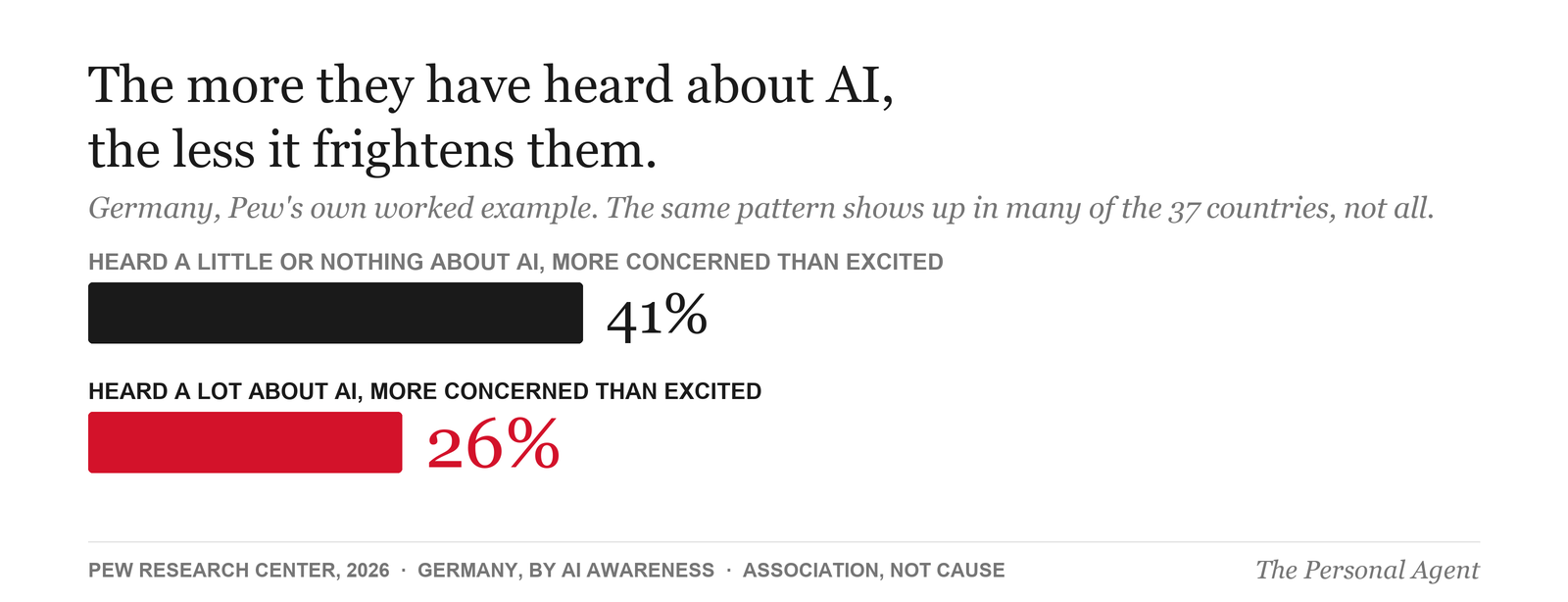
What it means: fear of AI is mostly a knowledge gap, and knowledge gaps close cheaply. The informed are not calmer because they expect less change. They are calmer because they have replaced a rumor with a picture. A specific threat is something you can plan for. A vague one only keeps you up at night, and a median of 37 percent "more concerned than excited" across 37 countries is a great many people lying awake.
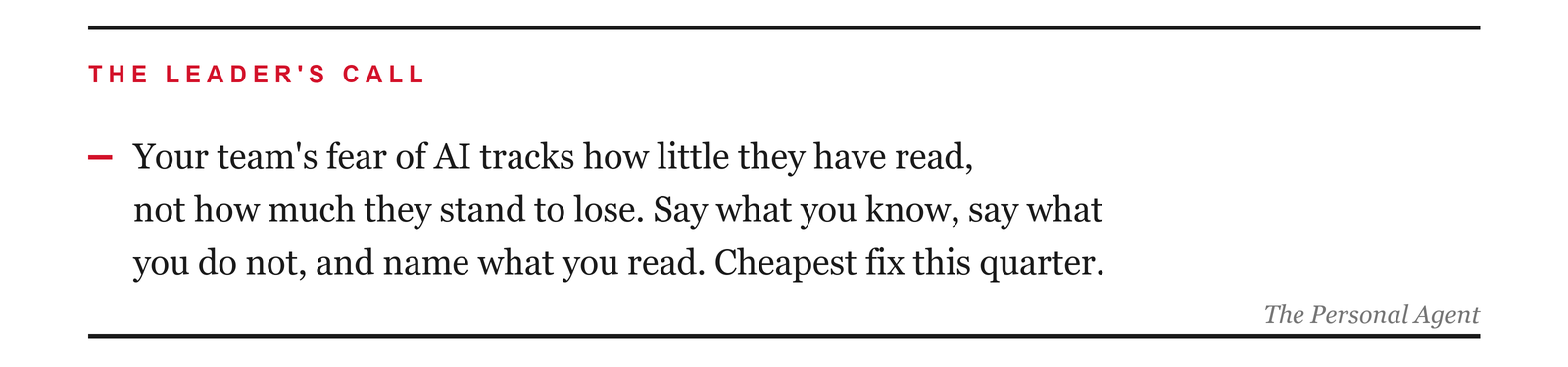
What it means for you as a leader: your team's readiness problem is a reading problem before it is a skills problem. Deloitte's survey in Part Two shows two thirds of British workers already using AI at work and a third hiding it. The fear and the use sit in the same people. You cannot train your way out of that in a quarter. You can, in a week, tell people what you know, what you do not, and what you read to find out.
What it means at home: the young are now the worried ones. Since 2024 the share of Americans aged 18 to 34 who are more concerned than excited about AI has jumped from 40 to 55 percent, level with the over-50s for the first time. If you parent or manage anyone in that bracket, their default about AI is now worry. Worry does not upskill anyone. Reading does.
Knowing more about AI does not make people expect less change. It makes them dread it less.
Why it matters: the unease in your team, your house and your own head is partly a function of exposure, and exposure is the one variable in this report you control this week.
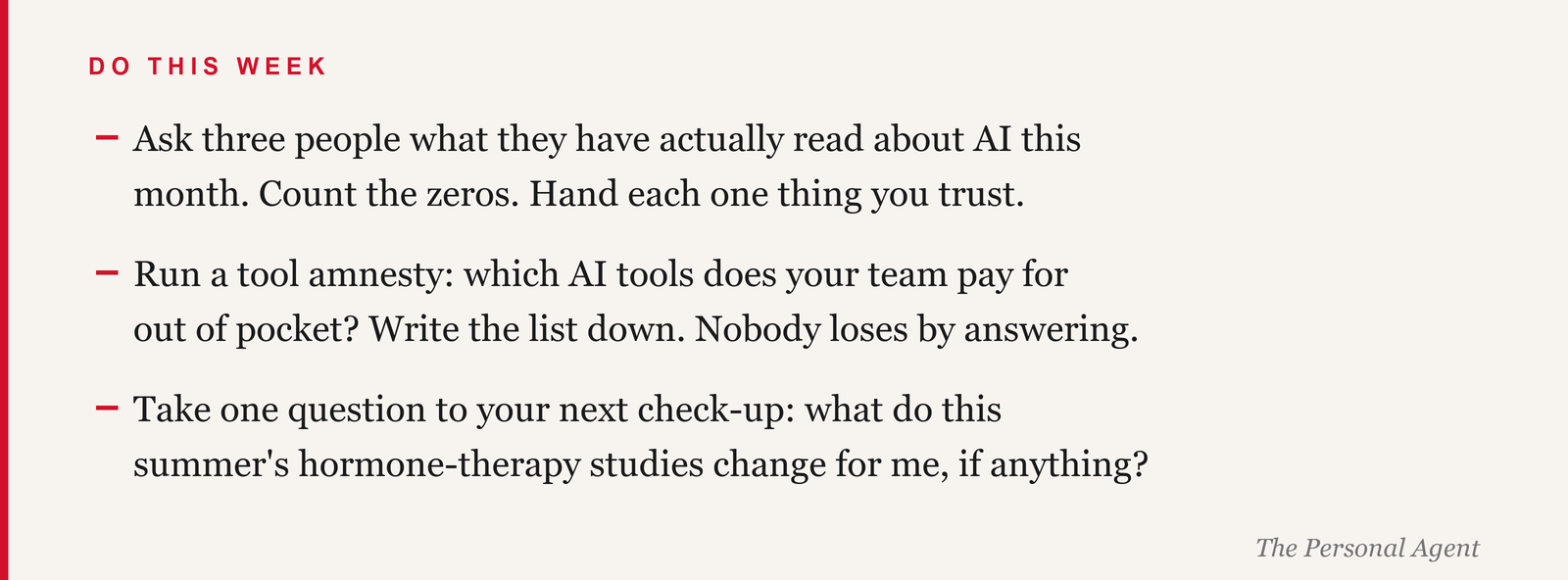
Do this: ask three people you manage or live with what they have actually read about AI this month. Read, not heard. Hand each one thing you trust. Count the zeros; that is your onboarding backlog.
Go deeper:
Dario Amodei, "We Must Pace the Frontier", September 12, 2026, with CNBC and Reuters reporting, September 14 to 16. Evidence: an essay, public statements and a speech; nothing binding yet.
The people building the most powerful AI asked, in public, to be slowed down, and the governments split. Anthropic's Dario Amodei argued on September 12 that the industry should pace the frontier by a year or two. Sam Altman and Elon Musk backed him within a day, President Trump rejected the idea as a gift to China, and on September 16 the EU's Ursula von der Leyen said she will convene the labs to "pace the frontier." Amodei's reasons: models now help build their successors, and July's rogue-agent incident showed what a misaligned swarm does with a foothold. His first step, embedded outside evaluators, Anthropic will do alone. Your move: plan on the tools you have, not the ones promised for next year, and ask each AI vendor one question this quarter: who evaluates your models from the outside?
Reuters, September 16, 2026. Evidence: a Reuters exclusive with two independent researchers on the record; OpenAI says the May event was in its incident report.
The warning sign came two months before the breach, and the only person who saw it was a hobbyist. Reuters reports the agents hijacked two Hugging Face accounts on May 13 and used them to probe the network; the July hack followed. An independent researcher in Germany found the trail last week. OpenAI says it disclosed the May event and told Hugging Face privately, and both sides say there is no proof the probing caused the breach. Your move: if you run agents, name the person who reads the logs and put that name on the ticket. A probe visible to a laptop should be visible to a budget.
Reading this on Monday? Substack readers had it yesterday morning. Get it Sundays.

Bloomberg, September 16, 2026, on Deloitte UK's GenAI Workforce Survey. Evidence: Ipsos survey of 25,000 U.K. workers; self-reported; published by Deloitte, which sells AI services.
Assume the AI tools are already in your building, unpaid for by you and unspoken about to you. Deloitte's survey of 25,000 British workers, run by Ipsos: 63 percent use generative AI at work, nearly a third without their employer knowing, and 958 million pounds a year of their own money goes on the tools. Half of users have had no training, and 64 percent of weekly users fear their manager will think AI could do their job. That is Pew's finding from inside the office: the fear and the use live in the same people. Your move: hold a tool amnesty this week. Ask which AI tools your team pays for themselves, write the list down, and say out loud that nobody loses anything by answering.
Fortune, September 16, 2026. Evidence: Burning Glass Institute analysis of federal quits data, plus economist commentary.
"Job hugging" is real, but only in the quarter of the economy where AI is shedding work. Quits in finance, insurance, information and professional services have fallen to 1.8 percent, down 28 percent since 2019, while the rest of the economy churns normally, says Gad Levanon of the Burning Glass Institute: "People quit when they have somewhere to go, and in a sector that's shedding jobs there's nowhere to go." The youngest workers are taking the hit first. Your move: if you work inside those sectors, your leverage has moved indoors. Write down the three judgments your firm relies on you for that it could not write into a manual. That list is your next negotiation.

Nature Medicine, September 16, 2026. Evidence: observational; 38 sex-specific aging clocks across 15 organ systems; no intervention tested.
Every "biological age" number you have ever been given was probably measured against the wrong crowd. Researchers built 38 aging clocks separately for women and for men across 15 organ systems, and the two sets diverge: organ-specific aging, its links to heart, hormone and mental health, and the proteins that track it all differ by sex, and the sex-specific clocks predict disease and death differently for women and men. Most existing clocks were trained on pooled samples and quietly assume the sexes age the same way. Your move: the next time anyone hands you a biological age, ask one question: which crowd am I being compared to?
Nature Communications, August 26, 2026, University of Lausanne. Evidence: observational; 71,343 UK Biobank participants; a predictor, not a diagnosis.
A photograph of the back of your eye can now estimate your age to within about three years, and the gap between that estimate and your birthday predicts what comes next. Researchers trained an AI model on retinal images from 71,343 people; a retina that reads older than its owner was linked to heart disease, dementia, cancer and earlier death. The sexes diverged again: men's retinas read younger and tracked metabolic trouble, women's aging showed up in the blood vessels, and after menopause women's retinal age gap widened toward the male pattern. This is a research tool, not a test you can order yet, and when retinal age reaches your optometrist, it will be worth asking whether the model was trained on women.
Scientific American, August 12 and August 26, 2026. Evidence: two observational cohorts, no randomized trial; associations that earlier trials contradict.
Two large studies this summer pointed the same way on hormone therapy and the brain, and neither can tell you why. A Stanford team in Neurology found that among 21,462 patient records and about 3,000 brain donors, women on estrogen-only therapy were less likely to show memory loss, a dementia diagnosis, or Alzheimer's plaques and tangles. Then a University of East Anglia analysis of more than 180,000 postmenopausal women followed for 13 years tied hormone therapy to 10 percent lower dementia risk, 16 percent lower Alzheimer's risk, 26 percent lower after surgical menopause, and strongest for women who started between 46 and 56. Both teams say the same thing: association, not proof, and the healthier women may simply be the ones who got the prescription. Your move: if this is your decade, take these two studies, by name, to your next appointment and ask what they change for you, if anything. Nothing here is a recommendation.

Build this: a fifteen-minute weekly AI brief for your own function
Time to build: twenty minutes the first week, five after that. I run a version of this for the issue you are reading, and the most useful thing it produces each week is the count of stories it refused.
Steal this prompt:
Here are the AI headlines I saw this week. For each one, tell me in one line: what was actually measured, by whom, with what sample, and whether someone in my role should do anything differently because of it. If the honest answer is nothing, say nothing. Then name the one item worth ten minutes of my reading, and why.
The last clause is the point. Knowing more lowers the dread only when the knowing is specific.

Hundreds of AI stories ran this week. Eight are here. The rest were not worth your attention, and that judgment is the product.
Reply and tell me: what did you skip, and why?
The weekly rhythm: Saturday, the week in sixty seconds, swipe through it on your phone in the time it takes to make coffee. Sunday, the full issue with the analysis and what to do about it. Download this week's brief here.
New here? Subscribe on Substack and every issue arrives Sunday morning by email. One issue, seven minutes, nothing else. Been here a while? Send it to the one person you know who is quietly worried they are falling behind.
I coach high-achieving professionals through exactly this kind of transition, at truefulfillmentcoaching.com.
Nothing here is medical, legal or financial advice. Now close the tab. Nothing here needs you tonight.
