Issue No. 4: Engagement did not follow the AI tools. It followed the managers.
By Ming Gosier, PCC · · All issues
The 60-second brief
The loudest story this week was a $12.9 billion acquisition. The one that will show up in your Monday is quieter: adoption is still climbing, engagement has not moved an inch, and the difference comes down to whether one person said what good looks like.
In this issue:
- Eighteen points of engagement sit behind a sentence most managers never say.
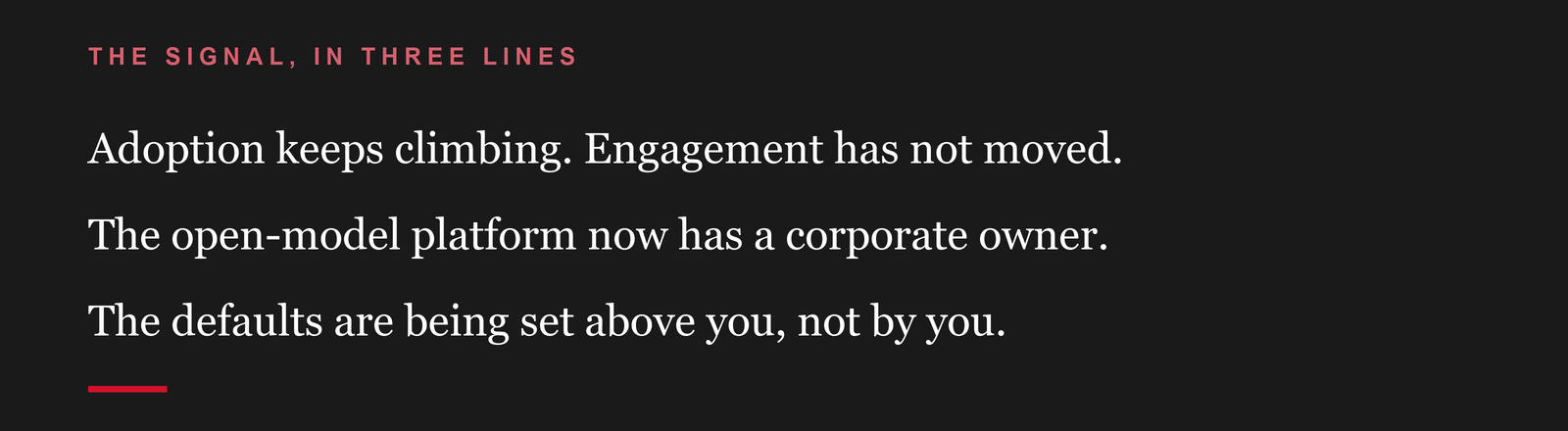
- Nvidia is buying Hugging Face. The platform the open-model world runs on has an owner.
- Ads have arrived inside ChatGPT, and your AI answers now sit beside paid placement.
- Caregivers burn out more than their colleagues, and the gap is measurable.
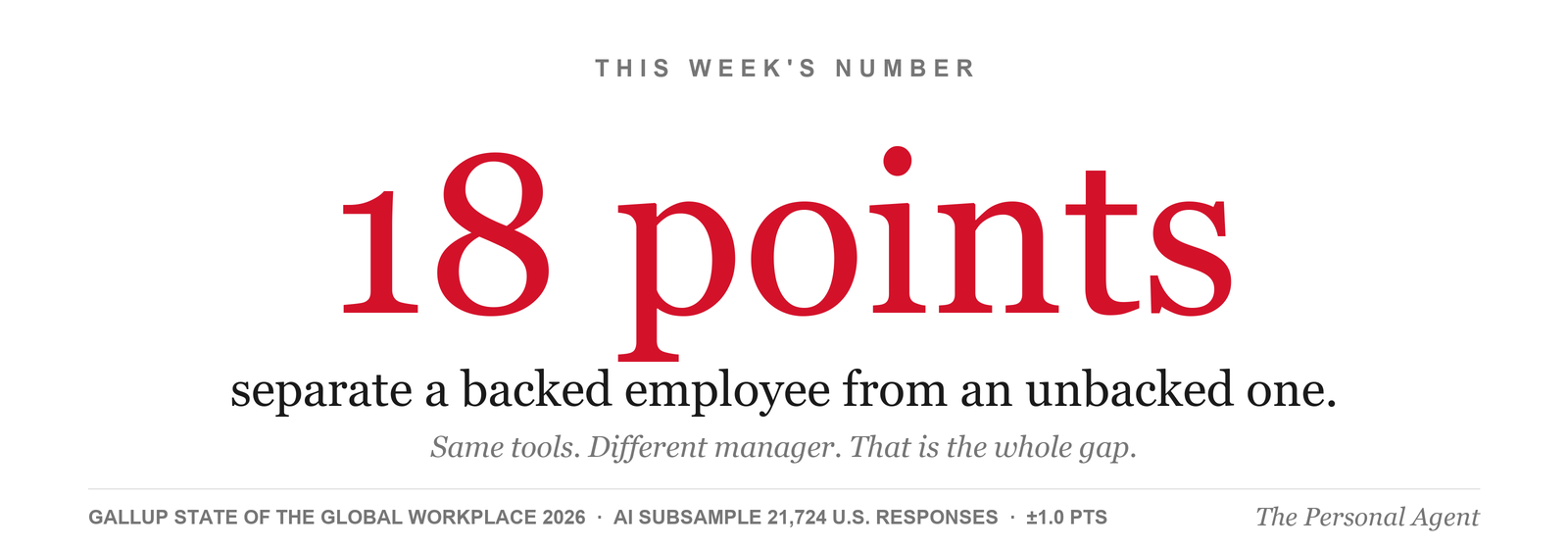

Engagement did not follow the tools. It followed the managers.
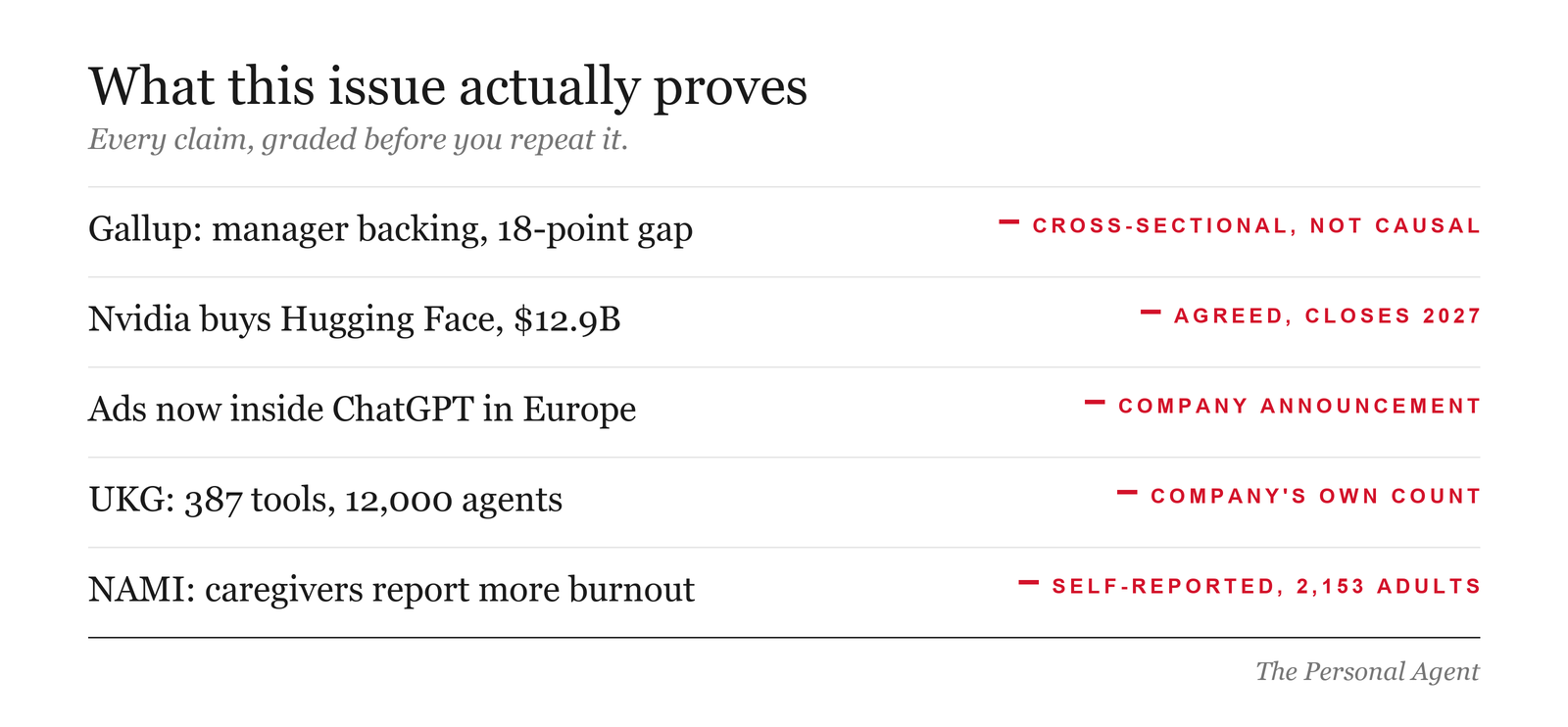
Gallup, State of the Global Workplace 2026, fielded February and May 2026. Evidence: 43,262 U.S. responses, ±0.7 points; AI subsample 21,724, ±1.0.
Adoption accelerated all year. Engagement did not move. The thing that tracks with it costs nothing and is not a tool.
American employee engagement sat at 31 percent in the first half of 2026, unchanged from 2025, while AI adoption climbed through the same period. Inside the same survey, though, engagement runs at 30 percent for employees whose manager does not support their AI use, and 48 percent for those whose manager actively does. When frequent use, a clear organizational plan, and manager support all line up, it reaches 53 percent.
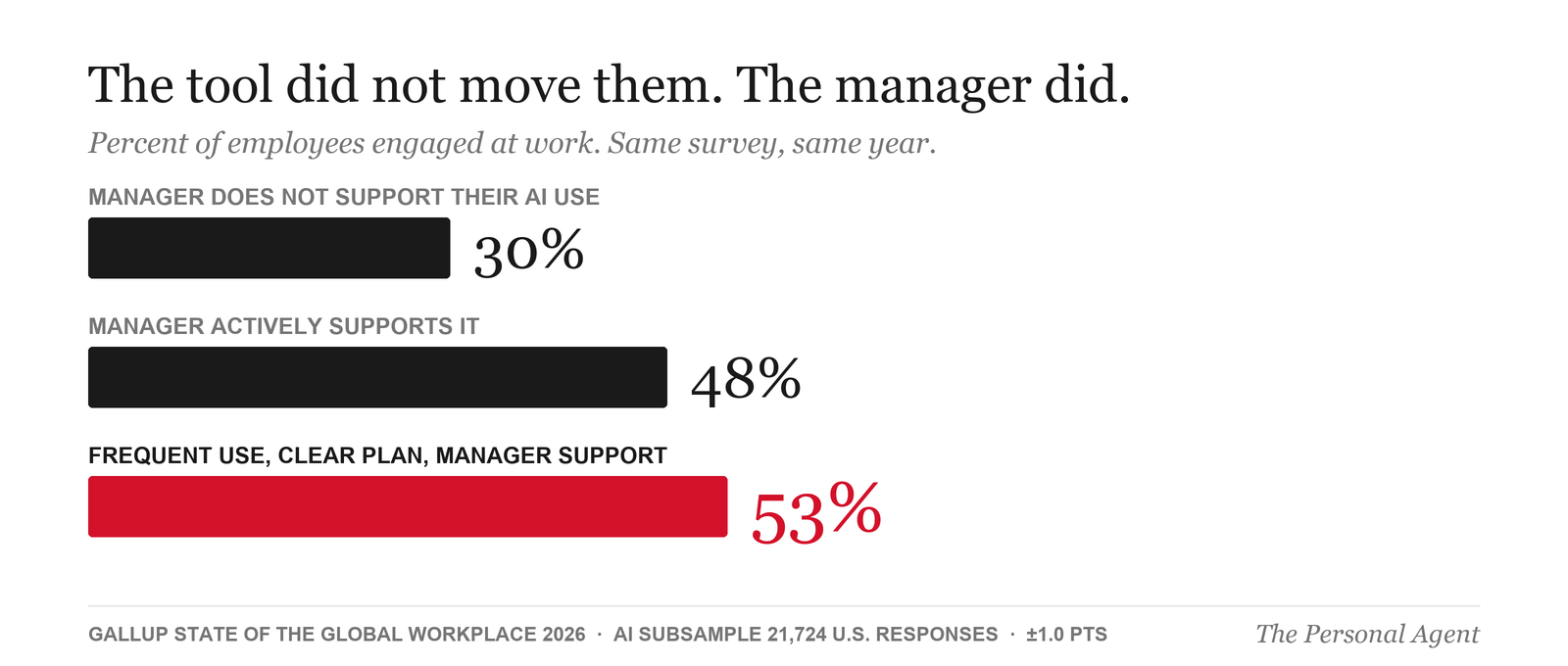
The tool is not the variable that separates them. This is survey data, so it shows association and not proof of cause, and engaged people may well seek out supportive managers as much as the reverse. The direction holds across three separate cuts, though. Everyone in that survey has roughly the same access to roughly the same models. What separates a 30 from a 48 is not the software budget. It is whether someone with authority said out loud that using this is fine, here is what good looks like, here is where the line is.
This is the same finding from a different angle as Issue No. 2. Half of us use AI and one in ten says it changed the work. The missing ingredient was never capability. It is permission and definition, which is a management act, not a procurement one. Access without expectations produces exactly what it sounds like: people quietly experimenting, unsure whether they are being clever or breaking a rule.
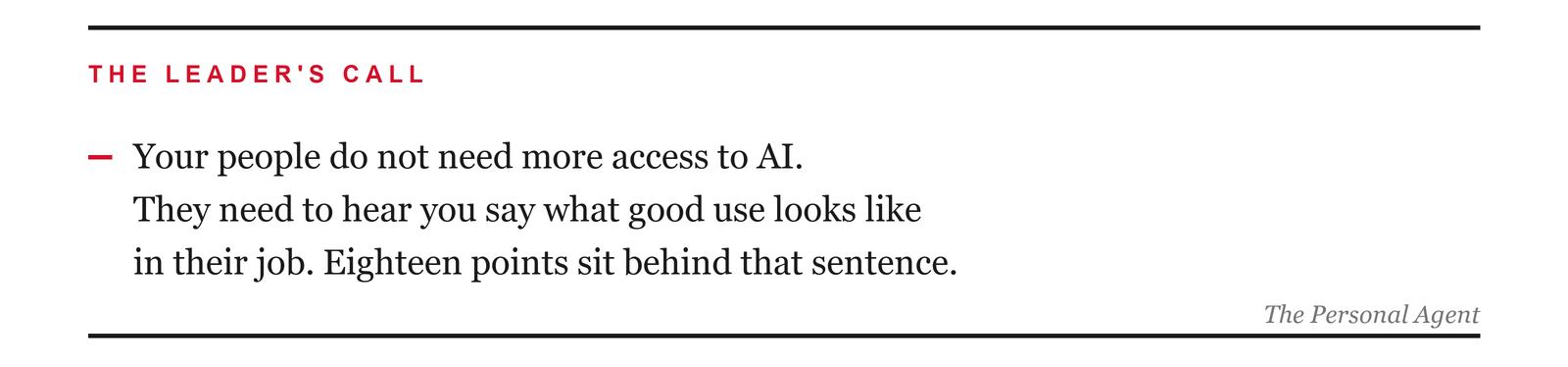
Eighteen points of engagement sit behind a sentence that takes nine seconds to say.
Why it matters: if you manage anyone, the highest-return AI investment available to you this quarter is not a license. It is a conversation you have not scheduled. And if you are managed, the absence of that conversation is now a measurable cost you are carrying.
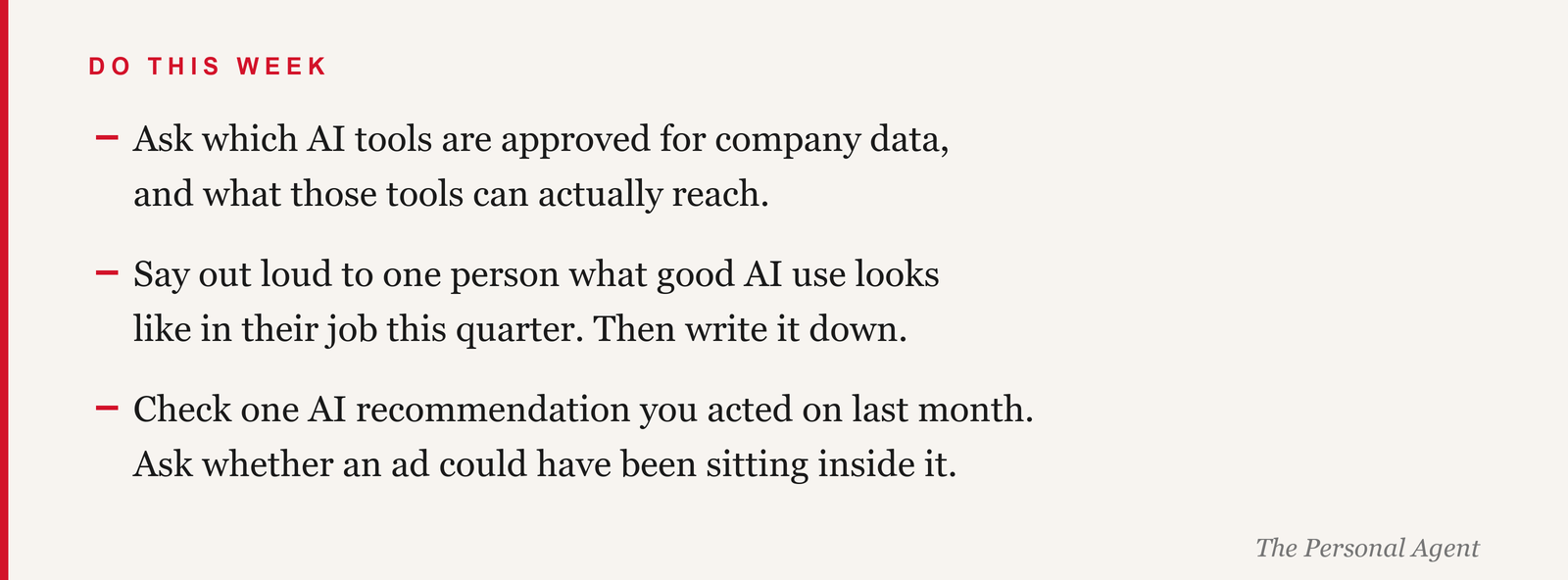
Do this: say to one person you manage, in plain words, what good AI use looks like in their specific job this quarter, and what you would not want them to hand over. If nobody manages you, write those two sentences for yourself.
Nvidia is buying Hugging Face, the platform the open-model world runs on
TechCrunch and CNBC, Sep 3, 2026. Evidence: confirmed acquisition, SEC filing dated Sep 2; deal expected to close in the first half of 2027.
Nvidia confirmed it will acquire Hugging Face for $12.9 billion, the repository where roughly 18 million developers share three million open models. Jensen Huang said the platform will stay open and that Nvidia compute will not be required to build or deploy there. Readers of Issue No. 2 will remember Hugging Face as the repository whose breach paused OpenAI's training. What changes hands is the hosting and distribution platform, not the models, the licenses, or the weights already sitting on people's machines. The commons keeps its contents and gains a landlord, and the same question follows both events: the AI you build on is infrastructure you do not control. Before your team standardizes on a tool, who owns it is a fair thing to ask.
The U.S. government took OpenAI's side on training data
TechCrunch, Sep 2, 2026. Evidence: reported government filing in ongoing litigation, not a final ruling.
The federal government formally backed OpenAI in the fight over training models on copyrighted material. This is a filing in live litigation rather than settled law, so treat the direction as a signal and not a verdict. The practical read for anyone who publishes: the rules about what may be learned from your work are being written now, in rooms you are not in, and the outcome will apply to your writing, your course, your slides and your voice.

Ads have arrived inside ChatGPT in Europe
OpenAI, announced Aug 18, live Aug 24, 2026. Evidence: company announcement, rollout confirmed by multiple outlets.
ChatGPT began showing ads across 31 European markets, six months after the same rollout in the United States, on the free tiers only and without personalization to comply with GDPR. OpenAI says ads stay separate from model responses. Either way, the era of treating an AI answer as a neutral oracle is closing: it is a surface with commercial interests attached, the way search results have been for two decades. That does not make the answers useless. It makes verification a professional habit rather than a personality trait.
A software firm let employees build their own AI, and got 387 tools
Fortune, Sep 2, 2026. Evidence: company's own figures, reported in interview.
UKG's CIO encouraged employees to build their own AI tools and reports 387 of them, plus more than 12,000 agents. The numbers are the company's own and unaudited, so hold them loosely. The pattern underneath is the interesting part, and it is the week's lead in a different costume: the organizations getting compounding returns are not the ones buying the most licenses, they are the ones that told people explicitly that building is allowed.
The logical end of AI job interviews is two bots talking
Wired, Sep 2, 2026. Evidence: reporting plus anecdote, no hiring-outcome data.
Candidates are now using AI to answer AI interviewers, which produces the absurd equilibrium in the headline. There is no outcome data here yet, so this is a trend piece and not a finding. But if you are hiring, the screening layer you added to save time may now be measuring how well applicants prompt. And if you are job hunting, the human conversation you can still get is worth more than it was a year ago.

Caregivers burn out more than their colleagues, and the gap is measurable
NAMI and Ipsos, fielded Jan 27 to Feb 2, 2026. Evidence: probability-panel survey, 2,153 full-time U.S. employees at firms of 100 or more, self-reported.
Employees with caregiving responsibilities reported burnout at 61 percent, against 49 percent for those without, and were more likely to say work demands had hurt their mental health, 48 percent against 34. The figures are self-reported, which is the honest caveat and also the point: this is a gap that shows up in how people feel long before it shows up in output. If you manage people with young children or aging parents, they are carrying a load your dashboards do not display.
Your capacity for stress is not fixed, and the season moves it
Scientific American, Aug 29, 2026. Evidence: observational research, association only.
Reviewed evidence suggests stress resilience shifts with the seasons, with lower energy and weaker immune function reported in winter months. It is observational work, so it describes a pattern rather than proving a mechanism, and it is not clinical guidance. It arrives at a useful moment, though: the quarter that ends in December is planned in September, usually by people assuming their December self will have the same capacity as their September self.

Build this: the nine-second sentence, written down
- Pick one person you manage, or one role on your team if you manage several.
- List the three tasks in that role you would be glad to see AI take a first pass at, and the two you would not want handed over at all.
- Ask an assistant to turn those five items into a short paragraph a person could read in under a minute, in plain language, no policy voice.
- Cut every sentence that hedges. "May consider using where appropriate" tells nobody anything.
- The gate: the assistant may draft and tighten the wording. It may not decide which tasks are on which list, and the paragraph does not go out until you have said it aloud to the person first. The document records the conversation; it does not replace it.
Time to build: thirty minutes. The hardest part is list two, because "what I do not want handed over" is usually where the judgment you were promoted for actually lives.
Steal this prompt:
Here is a role on my team and the work it covers. Ask me one question at a time, up to ten, to sort that work into three buckets: AI takes a first pass, AI never touches it, and unclear. Push back when my reasoning is vague. At the end, write the unclear list as questions I should answer before anyone on my team asks me.
The unclear list is the useful output. Those are the questions your team is already guessing the answers to.

Hundreds of AI stories ran this week. Eight are here. The rest were not worth your attention, and that judgment is the product.
Reply and tell me: what did you skip, and why?
The weekly rhythm: Friday, the week in sixty seconds, swipe through it on your phone in the time it takes to make coffee. Monday, the full issue with the analysis and what to do about it. Download this week's brief here.
New here? Subscribe and this arrives every week. One issue, seven minutes, nothing else. Been here a while? Send it to the one person you know who is quietly worried they are falling behind.
I coach high-achieving professionals through exactly this kind of transition, at truefulfillmentcoaching.com.
Nothing here is medical, legal or financial advice. Now close the tab. Nothing here needs you tonight.
