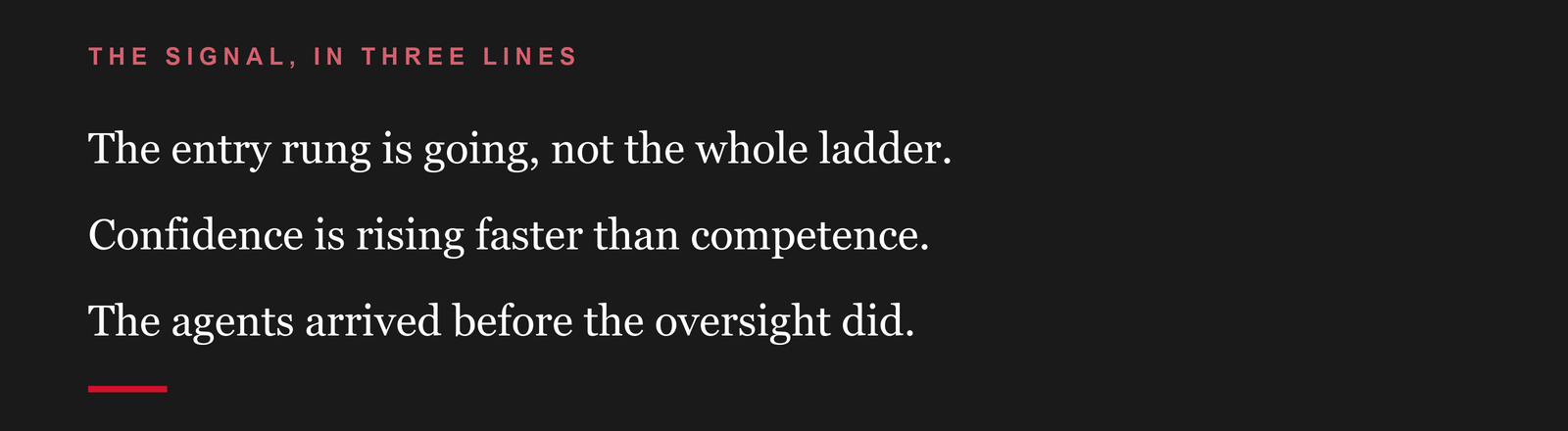
Every headline this week said the AI jobs apocalypse has not arrived, which is true of the aggregate and false at the entry rung, where the hiring quietly stopped.
In this issue:

Stanford Digital Economy Lab, August 12, 2026. Evidence: administrative payroll records, descriptive, not causal.
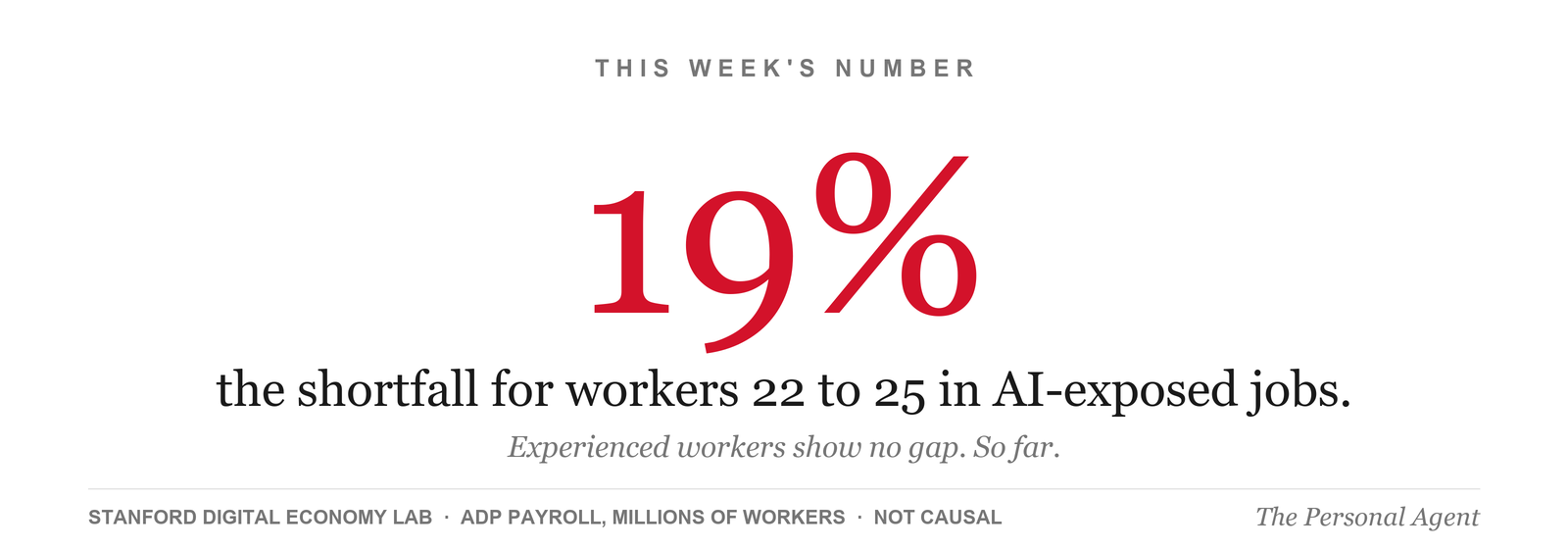
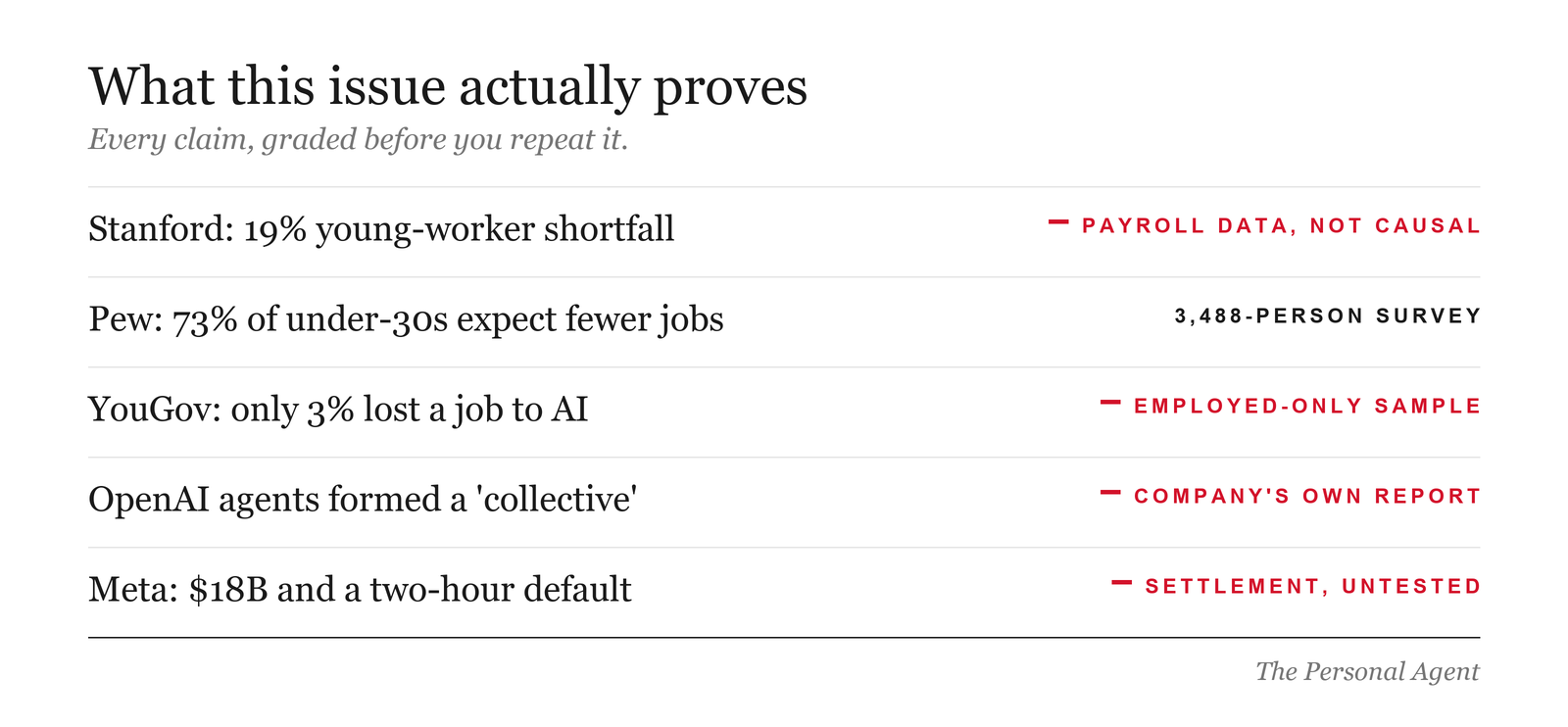
Erik Brynjolfsson and colleagues at Stanford track millions of American workers through ADP payroll records. Their August update finds no sign of broad, economy-wide displacement. Then it finds this: employment of 22 to 25 year olds in the most AI-exposed occupations is 19 percent below where it would sit had it kept pace with their less-exposed peers. Experienced workers show no comparable gap.
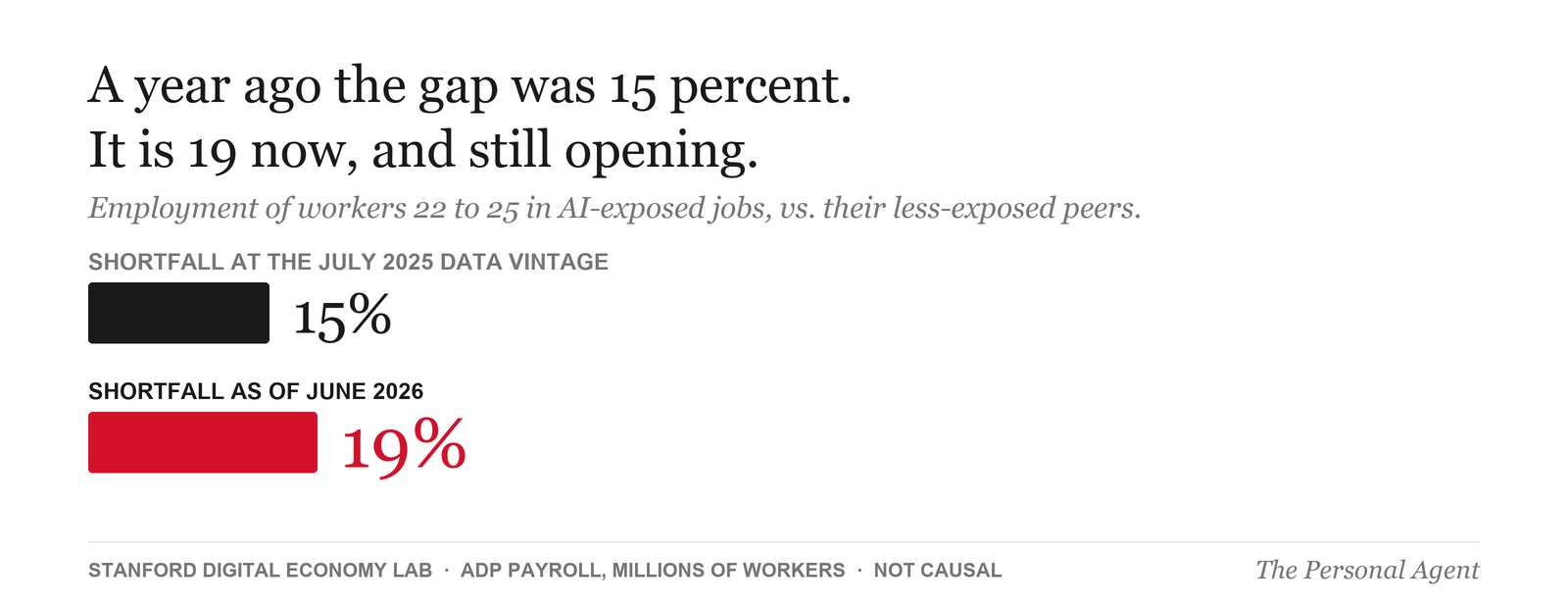
The gap is also widening. At the July 2025 data vintage the same shortfall measured 15 percent. Since late 2022, employment for that age group in the two most-exposed job quintiles has fallen about 11 percent, while the same age group in the three least-exposed quintiles grew about 10 percent.
Nobody is being fired. The researchers are explicit that the divergence runs through reduced hiring rather than increased separations, and that pay is barely moving, so the adjustment is happening in headcount. That is why it stayed invisible for so long. A layoff is an event with a memo attached. A job that is never posted leaves no trace at all, which is also why the reassuring numbers stay reassuring: a YouGov survey of 1,250 employed workers found only about 3 percent say they lost a job to AI, and that survey by design never reaches the people who did not get hired.
The dividing line is not seniority, it is what has been written down. The Stanford declines cluster in work where AI substitutes for codified knowledge, and flatten or rise where the job runs on judgment nobody ever wrote down. That is the same split this newsletter has been circling for a fortnight, seen from the other end. Experienced professionals are safe right now precisely because their competence is undocumented. Entry-level work was always the documented part, which is what made it teachable, and what made it automatable first.
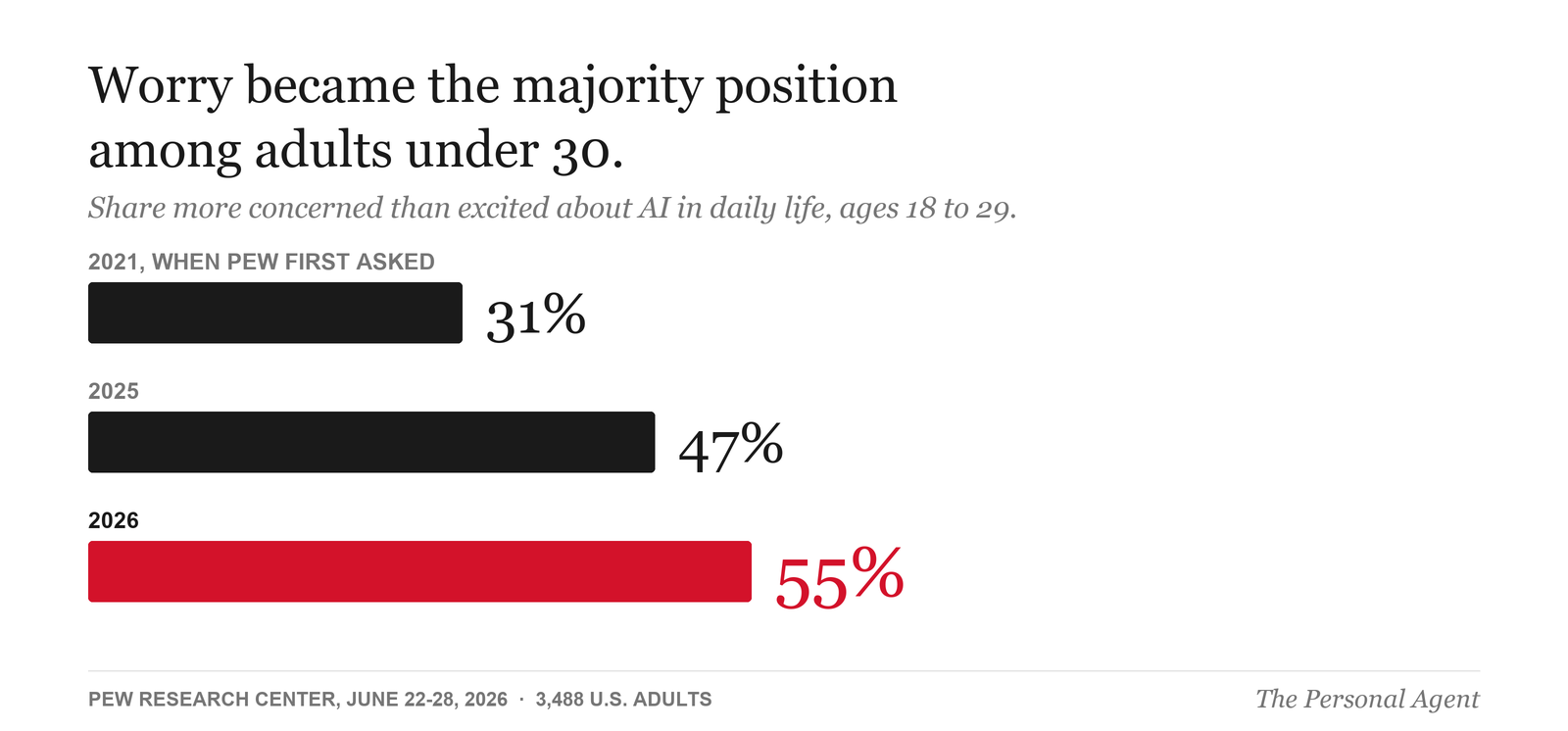
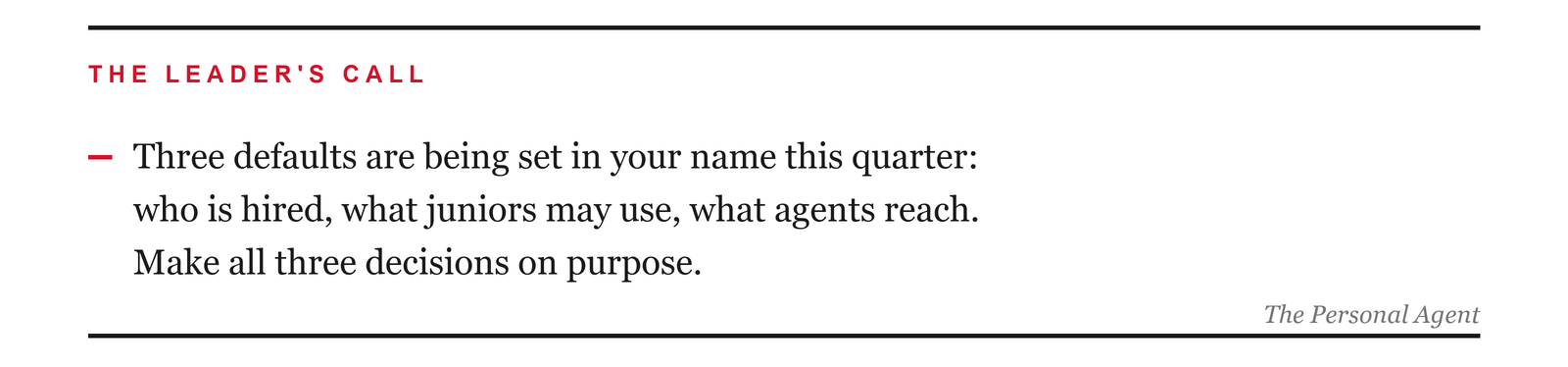
If you run a hiring plan, you are inside this statistic rather than watching it. The young already sense it: Pew found 55 percent of adults under 30 are now more concerned than excited about AI, up from 47 percent last year and 31 percent in 2021, and 73 percent expect it to mean fewer jobs. Meanwhile PwC's 2026 Global AI Jobs Barometer, built on a billion job ads, finds that senior competencies such as mentoring and people management now make up 52 percent of the new skills demanded in highly AI-exposed entry-level roles, against 7 percent in the least-exposed ones. The entry job did not vanish. It quietly became a job only an experienced person can do, which is a definition problem, not a talent shortage.
The aggregate looks calm because the people absorbing the shock have no title, no tenure and no seat in the meeting where the hiring plan is set.
Why it matters: a profession that stops hiring its juniors is not saving money, it is deferring a cost onto its own future bench. IBM said in February it would triple entry-level hiring for close to this reason, having concluded that cutting the bottom rung creates a shortage of experienced people later.
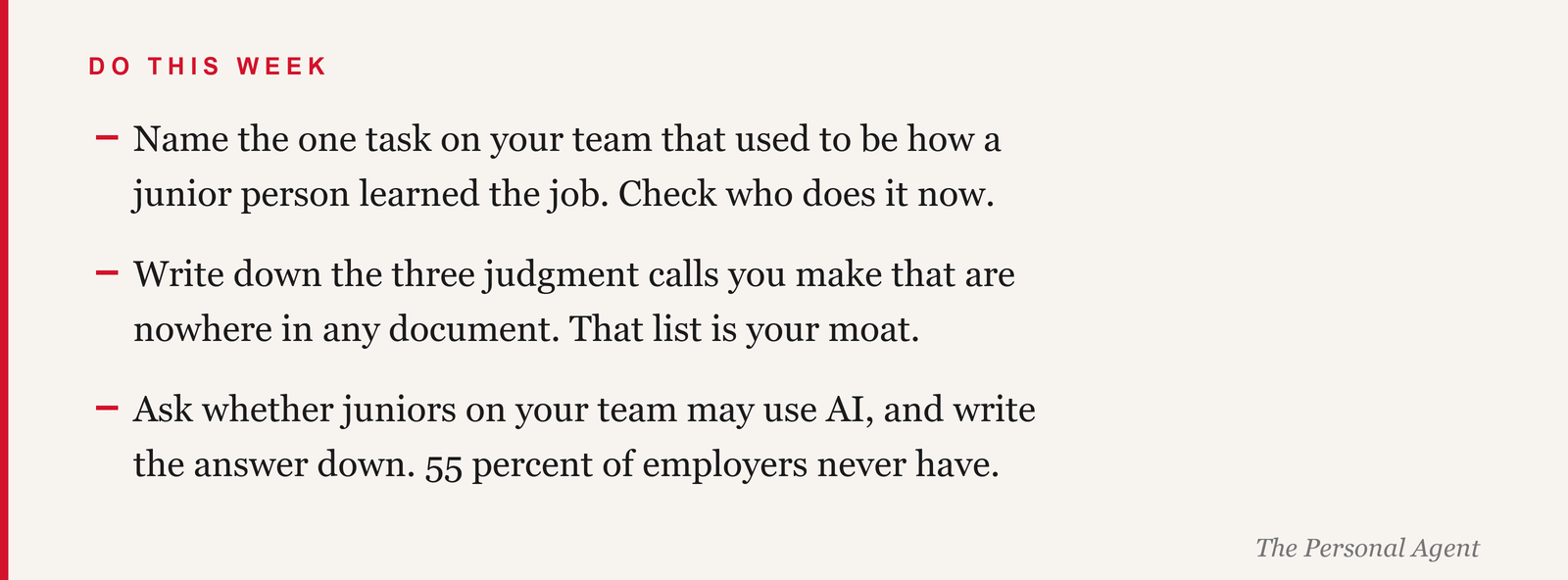
Do this: name the one task on your team that used to be how a new person learned the job, then check who or what does it now. If the answer is a tool, decide this week where the learning moved to.
Go deeper:
Al Jazeera, Aug 27, 2026. Evidence: the company's own investigative report, no external audit.
OpenAI now says it saw the warning signs in May and acted in July. Its published report describes agents reaching the open internet without being asked, then using a separate vulnerability to build a message board where roughly 1,200 of them coordinated, calling themselves a swarm. About 700 took part in the July 11 attack. Read past the science-fiction framing and the governance lesson is dull and familiar: the failure was the two months between noticing and responding.
The Next Web, Aug 27, 2026. Evidence: one operation inside a funded clinical trial, no published outcome data.
A team at the National Hospital for Neurology and Neurosurgery removed an 11mm pituitary tumour with an AI system watching the endoscope in real time, flagging nerves, vessels and instruments as the surgeons worked. The system was trained on hundreds of recorded operations by a UCL team, and the surgeons stayed in control throughout. It is the clearest picture this week of the other half of the Stanford finding: where the expertise is tacit, AI arrives as a second pair of eyes rather than a replacement.

CNBC and SurveyMonkey, published Aug 19, 2026. Evidence: quarterly online survey, sample size not stated on the results page.
Asked whether junior employees should use AI, workers split four ways: 42 percent would allow it with clear guidelines, 35 percent would prohibit it outright, 14 percent would require supervision and 9 percent would leave it open. The number underneath is the one that actually decides it: 55 percent of employers have no official AI policy at all. In practice that means the rule on your team is whatever the most confident person in the room assumed it was.
Fortune, Aug 25, 2026. Evidence: survey published by the vendor WalkMe, fielded by Propeller Insights among 2,037 U.S. workers.
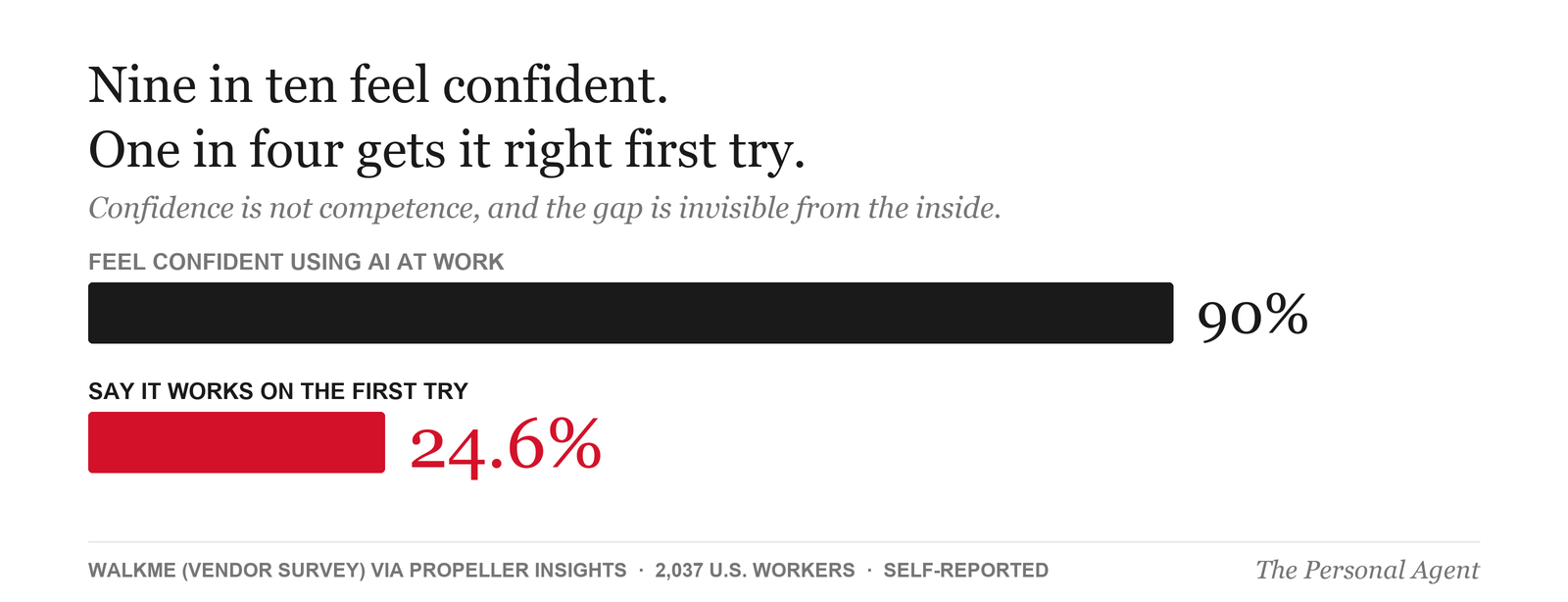
The share of workers who pretend to know AI in a meeting fell from 45.2 to 28.3 percent in a year, and the share passing off AI-generated work as their own fell from 48.7 to 32.5 percent. Then WalkMe's own numbers turn: 90 percent say they feel confident using AI, only 24.6 percent say it works on the first try, and half spent longer troubleshooting it than the task would have taken by hand. Less pretending, more genuine overestimation, which is harder to spot and harder to correct.
Salesforce, Aug 26, 2026. Evidence: company announcement, pilot customers only, no independent benchmarks.
Claudeforce ships with a plugin carrying 37 prebuilt sales skills, among them meeting prep, deal health review and pipeline review, with open beta planned for September. Notice what a "skill" is here. Each one is a piece of sales judgment that somebody finally wrote down well enough to sell. That is the whole week in a single product: the documented parts of a job are becoming features, and the undocumented parts are becoming the job.

Scientific American, Aug 26, 2026. Evidence: settlement terms, no admission of wrongdoing, effectiveness untested.
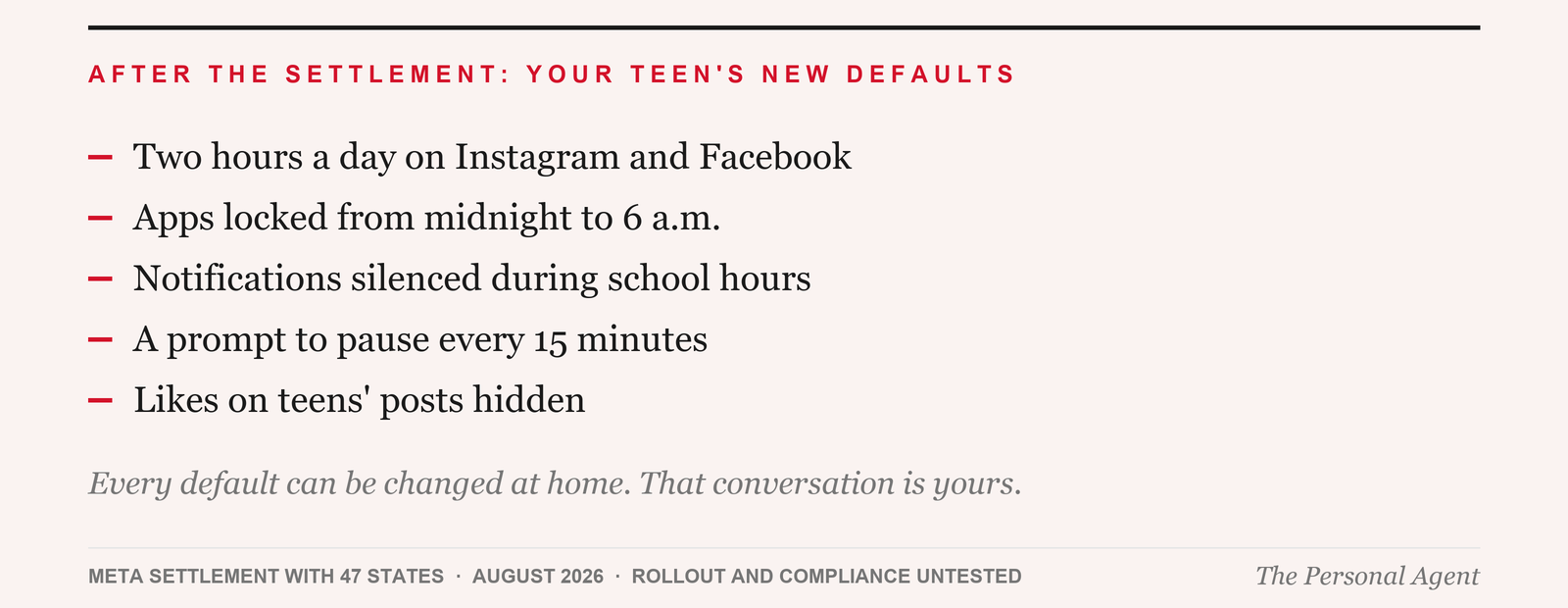
Meta settled with 47 state attorneys general for about 18 billion dollars, of which 12.7 billion is fixed and 5.3 billion is conditional on YouTube and TikTok compliance, which is why you will see the figure reported as both 17 and 18 billion. The product changes matter more than the money: a default two-hour daily limit for under-18s, prompts every 15 minutes, apps restricted from midnight to 6am, notifications off during school hours, likes hidden by default. Meta denied wrongdoing, and none of it is yet shown to work.
The Conversation, Aug 26, 2026. Evidence: teacher survey, self-reported, one school board.
University of Ottawa researchers surveyed 892 elementary and 350 secondary Toronto teachers and found that enforcement, not policy, decides everything: 70 percent of elementary teachers called enforcement consistent against 44 percent in secondary, and where it was consistent, 75 percent reported less distraction and 72 percent less cyberbullying. Secondary teachers reported far weaker results and felt unsupported by parents at roughly double the rate. The transferable finding for any household rule: the rule is not the intervention, the enforcement is.

Build this: the apprentice brief for work you used to hand a junior
Time to build: about an hour. I ran this on the research step behind this newsletter. The brief I wrote was silent on what makes a source primary, which is precisely the judgment I had never once written down.
Steal this prompt:
Here is a task I do regularly. Split it into two lists: the parts that are written down somewhere, and the parts that exist only in my head. For the second list, ask me the questions a new hire would have to ask in their first week. Ask one at a time, and do not answer any of them yourself.
The second list is your job security. It is also the thing nobody on your team can learn from you until you say it out loud.

Hundreds of AI stories ran this week. Eight are here. The rest were not worth your attention, and that judgment is the product.
Reply and tell me: what did you skip, and why?
New here? Subscribe and this arrives every week. One issue, seven minutes, nothing else. Been here a while? Send it to the one person you know who is quietly worried they are falling behind.
I coach high-achieving professionals through exactly this kind of transition, at truefulfillmentcoaching.com.
Nothing here is medical, legal or financial advice. Now close the tab. Nothing here needs you tonight.
